Educating Employees About Their Equity: A Founder’s Guide
Help employees understand and value their equity throughout the employee lifecycle. Give them clear guidance on vesting, company valuation, dilution, liquidity, and the decisions that affect their ownership.
Equity compensation is a form of non-cash compensation wherein employees receive company shares or the right to acquire them under predefined terms as part of their overall remuneration package.
For startup founders, equity compensation serves a purpose beyond reducing cash outflows. It helps attract and retain talented employees while aligning their interests with the company’s long-term growth. When plan participants understand that the value of their equity is tied to the company’s success, they are more likely to develop a stronger sense of ownership and remain committed to achieving shared objectives.
Key takeaways
- Equity education should begin before onboarding and continue throughout the entire employee lifecycle
- Clear, jargon-free communication helps employees better understand and appreciate their equity compensation
- Regular updates, personalized communication, and visual explanations improve engagement with equity programs
- Continuous feedback and accessible educational resources strengthen participants confidence in making equity-related decisions
- Transparent communication during both positive and challenging periods builds long-term trust
Your Plan Documents Are Your Primary Reference
The educational materials provided by your company are intended to help you understand your equity compensation in accessible terms. However, they do not replace your official plan documentation.
The documents that formally govern your equity are:
- Your equity plan document, which sets out the rules of the overall program
- Your grant agreement,which specifies the individual terms of your award, including grant date, vesting schedule, exercise price, and any applicable conditions
In all cases, your formal plan document and grant agreement take precedence. If any conflict exists between educational materials and your official documentation, the plan document and grant agreement will govern.
Participants are strongly encouraged to:
- Read their grant agreement carefully upon receiving an equity award.
- Retain copies of all plan-related documentation.
- Direct any questions about specific plan terms to their HR or legal team.
Why Equity Literacy Matters for Plan Participants
Equity compensation is often unfamiliar territory for employees. Salaries, bonuses, and other cash-based rewards are straightforward because their value is immediately apparent.
Equity, on the other hand, involves concepts such as vesting schedules, exercise prices, company valuation, liquidity, and taxation. Without adequate education, employees may underestimate the value of their equity or struggle to make informed decisions throughout their ownership journey.
This article explores practical strategies founders can adopt to educate participants about their equity and build an effective communication framework that supports long-term engagement.
Start with your employees’ current level of understanding
Every startup workforce consists of employees with varying levels of financial literacy. Treating every employee the same often results in communication that is either too simplistic or unnecessarily technical.
A more effective approach begins with understanding existing knowledge gaps. Once these gaps have been identified, founders can define clear learning objectives that address the areas where participants need the most support. This creates a structured educational program rather than a collection of disconnected explanations.
Employees should gradually develop an understanding of concepts that directly affect their ownership. These include the different forms of equity compensation, vesting schedules, company valuation, dilution, liquidity events, and relevant tax considerations.
The objective is to provide sufficient context for employees to appreciate the value of their equity and confidently interpret future updates.
Make equity education part of the employee lifecycle
Many companies introduce equity compensation during the hiring process and rarely revisit the topic afterwards. This often leaves plan participants with unanswered questions as they progress through different stages of their equity journey.

Education should begin when an offer is made. At this stage, founders should explain equity using simple language alongside salary and other benefits so candidates can understand the complete compensation package.
Education should continue well beyond onboarding and first offers. Regular learning sessions allow participants to refresh their understanding while staying informed about new developments. New employees can be introduced to the company’s equity philosophy, plan structure, vesting conditions, and the long-term role equity plays within the organization.
Similarly, communication should not end when an employee leaves the company. Founders should clearly explain the status of vested equity, exercise deadlines where applicable, and any ownership rights that continue after employment.
Clear communication during offboarding reduces uncertainty and helps preserve positive relationships with former plan participants.
Use multiple educational resources to reinforce learning
Employees absorb information in different ways. Some prefer written references that they can revisit whenever needed, while others understand complex concepts more easily through presentations or interactive discussions.
Founders can improve understanding by combining several educational formats rather than relying on a single communication channel. Written guides provide a reliable reference for frequently asked questions, while instructional videos can simplify complex concepts through visual explanations. Newsletters can keep employees informed about company developments that affect equity, and town hall meetings create opportunities for employees to seek clarification directly.
Providing ongoing support is equally valuable. Some employees may require additional guidance even after attending educational sessions. Establishing dedicated points of contact within the finance or human resources teams gives employees a trusted resource whenever questions arise. This continuous support helps ensure that uncertainty does not accumulate over time.
Feedback should also become part of the education process. Asking employees whether existing resources answered their questions allows founders to identify gaps and continuously improve future communication.
Help employees understand how company events affect their equity
Employees are more likely to value their equity when they can understand how business events influence its potential value.
This requires founders to move beyond simply announcing developments. Funding rounds, valuation changes, liquidity events, and additional equity issuances should be accompanied by explanations that connect these events to employees’ ownership. Without this context, important announcements may create unnecessary confusion.
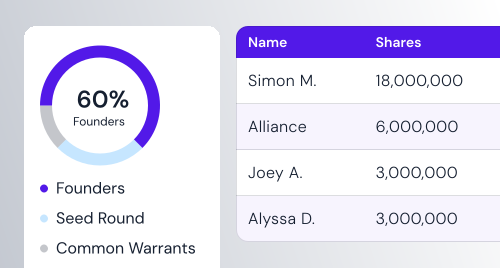
Visual communication can significantly improve comprehension. Charts, timelines, dashboards, and personalized summaries often explain equity concepts more effectively than lengthy written updates. Rather than expecting plan participants to perform their own calculations, founders can present information in formats that clearly illustrate vesting progress, ownership changes, or potential outcomes under different scenarios.
Providing employees with access to equity-related dashboards or tracking tools can further improve transparency. Features such as vesting trackers, scenario modelling, and personalized equity summaries help employees independently monitor their ownership while reducing administrative queries.
Founders should also remember that communication becomes even more important during difficult periods. If company performance declines or market conditions affect equity values, maintaining transparency helps preserve trust. Honest communication allows employees to understand the situation without relying on speculation.
Understanding Insider Trading Restrictions and Blackout Periods
Equity ownership comes with important legal responsibilities that every plan participant must understand. Holding company shares or options means participants may, at certain times, have access to material non-public information (MNPI) ,information that is not yet available to the general public but could influence an investor’s decision to buy or sell shares.
Trading on the basis of MNPI is illegal. This applies regardless of whether the participant is a senior executive or an entry-level employee. The legal consequences of insider trading can include significant financial penalties, disgorgement of profits, and criminal prosecution.
To help participants remain compliant, most companies implement blackout periods, defined windows of time during which plan participants are prohibited from buying, selling, or exercising equity. Blackout periods typically coincide with sensitive business events such as:
- Earnings announcements
- Pending mergers or acquisitions
- Material corporate transactions
- Fundraising rounds (for private companies)
Outside blackout periods, participants may trade only during designated open trading windows, which are typically communicated by the company’s legal or compliance team.
Clawback Provisions, What Employees Need To Know
Receiving an equity grant does not always mean that compensation is permanently secured. Many equity plans include clawback provisions, contractual terms that allow a company to reclaim previously awarded or paid equity compensation under certain defined circumstances.
Plan participants should understand that clawback provisions are increasingly standard practice, not an exception. In the United States, the SEC’s adoption of Rule 10D-1 under the Dodd-Frank Act requires listed companies to maintain and enforce clawback policies for erroneously awarded incentive-based compensation. Many companies have extended similar policies beyond their legal obligations as part of broader corporate governance frameworks.
Clawback provisions may be triggered by circumstances such as:
- Financial restatements that reveal previously reported results were inaccurate
- Misconduct, fraud, or serious violation of company policy
- Breach of non-compete or non-solicitation agreements
- Departure from the company within a defined period following an equity grant
- Regulatory investigations or legal proceedings
FAQs
Below are answers to frequently asked questions about equity compensation. These responses are intended as general guidance only and do not constitute tax or legal advice.
What are the different types of equity compensation?
Common forms of equity compensation include stock options, RSUs, PSUs, SARs, ESPPs, and phantom shares. The right instrument will depend on the company’s jurisdiction, stage of growth, and compensation objectives.
What is the exercise price?
The exercise price is the amount an employee pays to purchase shares when exercising stock options. Employees should clearly understand this price, along with the applicable exercise period and vesting conditions, before making decisions about their options.
What is the tax advantage of equity compensation?
Tax treatment of equity compensation varies by instrument, jurisdiction, and the timing of key events. In the US, ISOs may qualify for long-term capital gains treatment if specific holding periods are met, though AMT may apply. Outside the US, rules differ significantly; the UK, for example, offers tax-advantaged schemes such as EMI, SIP, and SAYE.
Eqvista – Empowering Founders Through Better Equity Communication!
Equity compensation delivers its greatest value when employees understand how it works and why it matters. A structured education strategy enables founders to communicate complex concepts with clarity, reinforce long-term ownership thinking, and build trust throughout the employee lifecycle. As your company grows, maintaining transparent and consistent communication becomes just as important as designing the equity plan itself.
Eqvista helps startups manage equity efficiently while providing the tools needed to improve transparency and employee understanding. From cap table management to equity administration, Eqvista supports founders in building equity programs that employees can confidently navigate. Contact us to streamline your equity management and strengthen employee engagement!
Start Managing Your Equity with Eqvista
Build your cap table, manage equity, and keep ownership organized as your company grows.