Recently, OpenAI became the world’s second-most valuable startup after a $40 billion funding round, reaching a valuation of $300 billion. In 2025, we are no strangers to such headlines regarding AI startups. For instance, Safe Superintelligence reached a valuation of $32 billion without even having a product.
With such strong hype surrounding the sector, keeping oneself grounded can be extremely crucial. This article will discuss how to value AI startups in 2025 accurately.

What makes AI startup valuation different?
AI startups face a different economic environment than traditional software companies. Their value often comes from things like unique datasets, trained models, skilled teams, and the way machine learning improves over time. These assets are hard to measure with standard methods.
Industry data consistently shows that AI startups at Series A command significantly higher pre-money valuations than non-AI software peers, reflecting both the perceived strategic value of AI and the complexity of accurately assessing it.
Knowing how to value an AI startup is important for founders raising money, investors doing research, and companies looking to buy others.
Why AI startups command premium valuations
Before diving into methodologies, it is important to understand the structural factors that often justify (or inflate) AI startup valuations:
| Value Drivers | Why It Matters |
|---|---|
| Proprietary Data Moats | Unique, hard-to-replicate datasets create sustainable competitive advantages that compound over time. |
| Network Effects in ML Models | Models that improve with more users/data create self-reinforcing value loops. |
| Talent Scarcity | Top AI/ML researchers and engineers remain in extremely limited supply, making teams themselves a valuation asset. |
| Platform Potential | Many AI startups can evolve from point solutions into horizontal platforms, dramatically expanding TAM (Total Addressable Market). |
| Strategic Acquisition Premium | Large technology companies (Google, Microsoft, Apple, Meta) routinely pay significant premiums to acquire AI capabilities. |
| Scalable Unit Economics | Once trained, AI models can often serve millions of users at marginal cost, producing software-like gross margins of 70–85%. |
The role of intellectual property in AI startup valuation
Intellectual property is one of the most significant drivers of AI startup worth. While data and talent often dominate valuation discussions, a startup’s IP portfolio can be the deciding factor in acquisition negotiations, investor due diligence, and long-term defensibility assessments.
Types of IP Relevant to AI Startups
| IP category | Examples | Valuation Impact |
|---|---|---|
| Patents | Novel model architectures, training methods, data processing techniques, hardware-software integration | Creates legal exclusivity; directly increases acquisition value and deters competitors |
| Trade Secrets | Proprietary training data pipelines, hyperparameter configurations, custom optimization techniques | Provides competitive advantage without public disclosure; difficult for competitors to reverse-engineer |
| Copyrights | Original training datasets, software code, documentation, technical publications | Protects original creative and technical works from unauthorized reproduction |
| Trademarks | Brand names, product names, logos | Protects market identity as the company scales |
| Licensing Agreements | Exclusive rights to third-party datasets, model architectures, or research outputs | Creates revenue streams and barriers to entry that enhance valuation |
How IP Directly Influences Valuation
Whether a company is seeking its first investment or negotiating a major acquisition, the quality and breadth of its IP portfolio can affect its valuation.
Here are four main ways IP can impact a startup’s valuation.
Defensibility Premium
Startups that hold patents on their core technology often receive higher valuations than those relying only on trade secrets or being first to market. For most large companies, intangible assets make up most of their value, and this is even more true for AI startups.
A strong patent portfolio shows investors and acquirers that the startup’s technology is protected and cannot be copied without permission. This lasts even if employees leave or competitors use open-source tools.
Acquisition Multiplier
During mergers and acquisitions, strong IP portfolios often lead to higher offers than what revenue alone would suggest. Buyers in the AI industry carefully review IP, and the quality of a startup’s patents can raise or lower the final price.
Licensing Revenue Potential
AI startups with solid IP portfolios can earn steady licensing income, even if that income isn’t tied to their main products. This is important for companies that create new methods, unique designs, or specialized hardware and software.
Freedom to Operate
A startup’s value can drop if it faces freedom-to-operate risks. Investors and buyers now often ask for FTO checks during their reviews. Startups that take steps to secure FTO, such as filing patents or entering into cross-licensing agreements, are seen as safer investments.
Why is the income-based approach appropriate for valuing AI startups?
Due to the high commercial viability of AI startups, they are able to reach key revenue milestones at an unprecedented pace. For instance, in just three years, Cursor reached annual recurring revenue (ARR) of $100 million. Examples of even faster commercialization do exist. Bolt, the AI app and website-building platform, reached an ARR of $20 million in just 2 months.
These trends hold up even when we take a more generalized view. Stripe’s data suggests that the median time to reach $5 million in annualized revenue for the top 100 AI startups (by revenue) was 24 months. In contrast, the top 100 SaaS startups (by revenue) of 2018 had a median time of 37 months for reaching $5 million in annualized revenue.
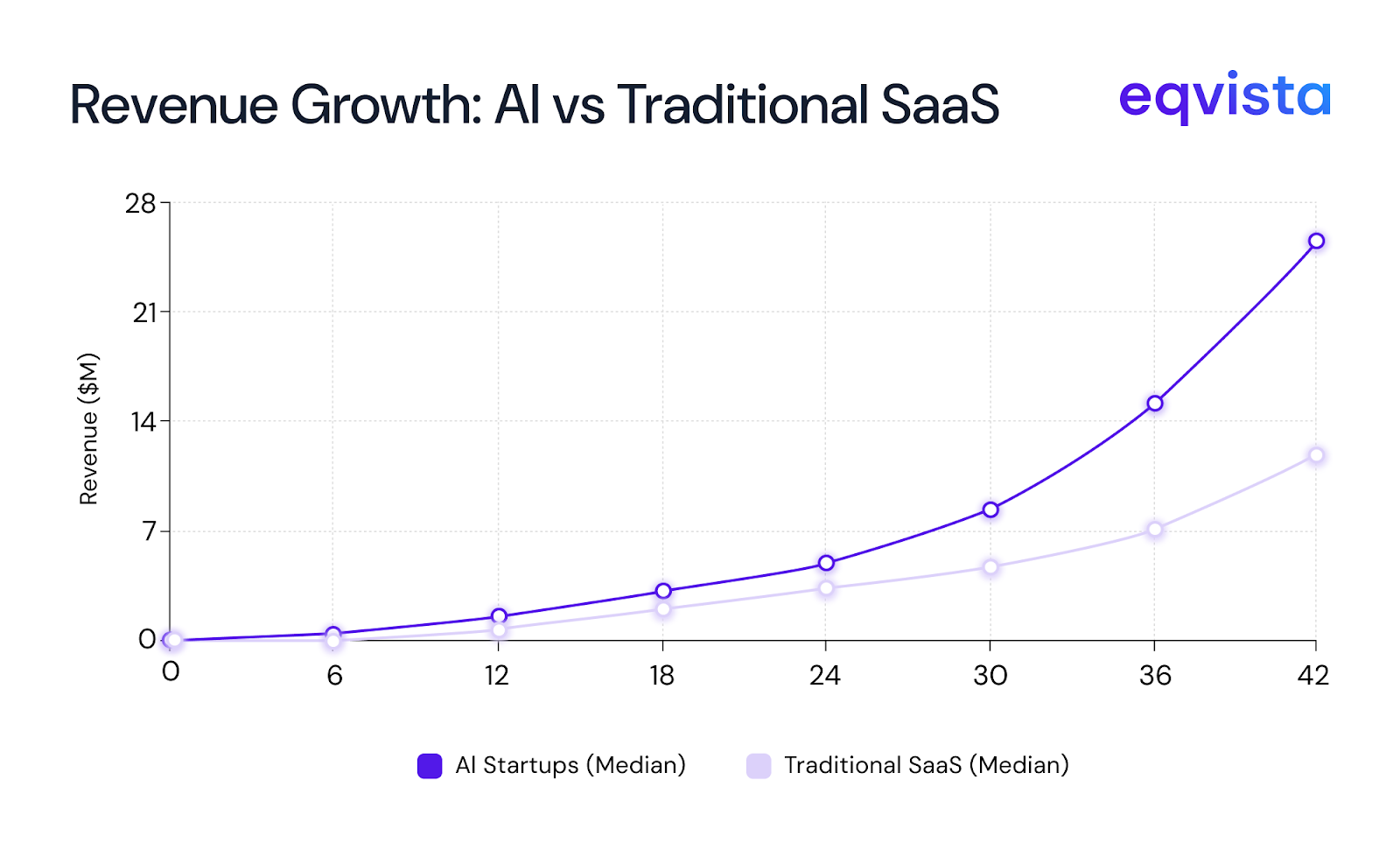
This depth of revenue history makes it easy to produce accurate results with the income-based approach.
The income-based approach involves building cash flow projections based on financial history, macroeconomic factors such as interest rates and GDP growth rate, and industry trends. Then, the projected cash flows are discounted to the present value and summed to arrive at the company’s valuation. Typically, the required rate of return is taken as the discount rate.
Example: Income-based Approach for valuing AI Startups
Let us understand this methodology using an example. Suppose that the financial performance of the AI startup you wish to value can be summarized as follows:
| Period | 2024 |
|---|---|
| EBITDA | $1,000,000 |
| Depreciation and amortization (D&A) | $100,000 |
| Earnings before interest and taxes (EBIT) | $900,000 |
| Tax rate | 21% |
| Tax | $189,000 |
| Earnings before interest (EBIT-T) | $711,000 |
| Depreciation and amortization (D&A) | $100,000 |
| Net working capital | $200,000 |
| Capital expenditures | $400,000 |
| Unlevered free cash flows (UFCF) | $211,000 |
The UN expects the global AI market to grow at a compounded annual growth rate (CAGR) of 38.19% until 2033. We will assume that the AI startup being valued would outperform the market and achieve an EBITDA growth rate of 57.29%, 1.5 times the global AI market growth rate. We will also assume constant capital expenditure and net working capital, while the depreciation and amortization (D&A) increases 10% every year.
We will also assume that the startup can be expected to be in operation for 5 years.
Based on this, we can make the following cash flow projections.
| Period | 2025 | 2026 | 2027 | 2028 | 2029 |
|---|---|---|---|---|---|
| Earnings before interest, taxes, depreciation, and amortization (EBITDA) | $1,572,900 | $2,474,014 | $3,891,377 | $6,120,747 | $9,627,323 |
| Depreciation and amortization (D&A) | $110,000 | $121,000 | $133,100 | $146,410 | $161,051 |
| Earnings before interest and taxes (EBIT) | $1,462,900 | $2,353,014 | $3,758,277 | $5,974,337 | $9,466,272 |
| Tax rate | 21% | 21% | 21% | 21% | 21% |
| Tax | $307,209 | $494,133 | $789,238 | $1,254,611 | $1,987,917 |
| Earnings before interest (EBIT-T) | $1,155,691 | $1,858,881 | $2,969,039 | $4,719,726 | $7,478,355 |
| Depreciation and amortization (D&A) | $110,000 | $121,000 | $133,100 | $146,410 | $161,051 |
| Net working capital | $200,000 | $200,000 | $200,000 | $200,000 | $200,000 |
| Capital expenditures | $400,000 | $400,000 | $400,000 | $400,000 | $400,000 |
| Unlevered free cash flows (UFCF) | $665,691 | $1,379,881 | $2,502,139 | $4,266,136 | $7,039,406 |
At the end of the forecast period, the startup is expected to have the following assets and liabilities.
| Particulars | Value |
|---|---|
| A. Assets | |
| Proprietary AI models | $6,000,000 |
| Brand and domain name | $1,000,000 |
| Software IP | $3,000,000 |
| Office equipment | $250,000 |
| Cash reserves | $2,500,000 |
| Accounts receivable | $2,000,000 |
| Total assets | $14,750,000 |
| B. Liabilities | |
| Loans | $2,000,000 |
| Accounts payable | $300,000 |
| Accrued salaries | $200,000 |
| Total liabilities | $2,500,000 |
Based on this, we will calculate the terminal value as the asset-based valuation at the end of the forecast period.
Terminal value = Asset-based valuation at the end of the forecast period
= Total assets – Total liabilities
= $14,750,000 – $2,500,000
= $12,250,000
We will assume that investors have low growth expectations and set a discount rate of 10%. Then, we can estimate the valuation as follows:
| Year | Unlevered free cash flows (UFCF) | Discounting factor | Discounted cash flow |
|---|---|---|---|
| 2025 | $665,691 | 1.1 | $605,174 |
| 2026 | $1,379,881 | 1.21 | $1,140,398 |
| 2027 | $2,502,139 | 1.331 | $1,879,894 |
| 2028 | $4,266,136 | 1.4641 | $2,913,829 |
| 2029 | $7,039,406 | 1.61051 | $4,370,917 |
| 2029 (Terminal value) | $12,250,000 | 1.61051 | $7,606,286 |
| Valuation | $18,516,498 |
So, even when an AI startup significantly outpaces the overall market growth and investors have low return expectations, the EBITDA valuation multiple reaches only 18.52x. This goes to show how unrealistic some of the growth expectations would be for certain AI startups.
Challenges in applying a market-based approach to AI startup valuation
Valuing an AI startup using the market-based approach can be challenging due to the extremely high valuation multiples commanded by certain AI startups. For instance, Hugging Face has a valuation multiple of 150x. In the past, startups such as Anysphere, Physical Intelligence, and Perplexity had valuations greater than 500x their respective revenues. Such high valuation multiples are probably the result of investors coming to expect rapid commercialization and revenue growth with AI startups.
Hence, overvaluation is a key concern when using the market-based approach for AI startup valuation.
One way to avoid this would be to account for how the startup in question stands out from the market. This would involve accounting for differences regarding patent portfolio, growth potential, or other key factors. For instance, OpenAI has a valuation multiple of 30x, much lower than that of Hugging Face. The key difference between these companies would be the fact that OpenAI is a relatively mature startup and is already a market leader. Hence, Hugging Face would have a relatively higher expected growth rate.
Example: Market valuation multiple for AI startup valuation
Let us understand how you can use the market valuation multiple for AI startup valuation with an example.
First, you must shortlist the AI startups with the same funding stage and industry segment. Then, you must divide the total valuations of these startups by their total revenue to arrive at the market valuation multiple.
Suppose you are valuing InnovaFlow, an AI and cloud-based operational planning platform. This startup’s last funding round was a Series B round, and its annualized revenue is $10 million. Your research suggests that the peers of this startup had the following annualized revenues and valuations.
| Company name | Annualized revenue (in millions) | Valuations (in millions) |
|---|---|---|
| CloudOpsIQ | $15 | $1,020 |
| StratifyAI | $17 | $323 |
| NimbusLogic | $11 | $143 |
| PlanForge | $16 | $192 |
| SynapseOps | $13 | $143 |
| AetherPlan | $19 | $323 |
| OptiFlow | $19 | $380 |
| CloudMinds | $11 | $165 |
| IntelliOps | $20 | $320 |
| NovaGrid | $15 | $270 |
| Total | $156 | $3,279 |
Based on this data, we can calculate the market valuation multiple as = Total valuation of all startups in the market/Total revenue of all startups in the market
= $3,279 million/$156 million
≈ 21.02
Now, we can calculate InnovaFlow’s valuation as = InnovaFlow’s annualized revenue × Market valuation multiple
= $10 million × 21.02
= $210.2 million
How to value an AI startup: Step-by-step framework
For practitioners seeking a structured approach, here is a recommended framework that synthesizes the methods discussed above:
Step 1: Classify the Startup
Start by figuring out the startup’s category and stage:
- Stage: Pre-seed, Seed, Series A, Series B, Growth
- Type: Infrastructure/foundational model, vertical AI application, AI-enabled SaaS, AI services/consulting, robotics/hardware AI
- Revenue status: Pre-revenue, early revenue (<$1M ARR), scaling ($1M–$10M ARR), growth ($10M+ ARR)
Step 2: Gather Comparable Data
Gather information on:
- Recent funding rounds for comparable AI startups
- Public company multiples for relevant AI-focused or AI-adjacent companies
- Recent M&A transactions in the sector
Step 3: Apply Multiple Valuation Methods
Try at least two or three methods to compare results:
- Pre-revenue: Scorecard/Berkus + Cost Approach + VC Method
- Early revenue: Market Comparables + VC Method + DCF (scenario-based)
- Growth stage: Market Comparables + DCF + Precedent Transactions
Step 4: Assess AI-Specific Value Drivers
Add both qualitative and quantitative assessments for:
- Data moat strength (1–5 scale)
- Model defensibility (1–5 scale)
- Team quality (1–5 scale)
- Scalability of unit economics (1–5 scale)
- Regulatory positioning (1–5 scale)
Step 5: Apply Risk Adjustments
Adjust the valuation to account for major risks:
- Technology risk (model failure, performance degradation)
- Market risk (competition, commoditization)
- Regulatory risk (adverse regulation, compliance costs)
- Customer concentration risk
- Key-person risk (dependency on specific researchers or engineers)
Step 6: Arrive at a Valuation Range
Show the valuation as a range instead of a single number. For example:
- Conservative case: $30 million (cost approach + risk discount)
- Base case: $50 million (market comparables, median multiple)
- Optimistic case: $80 million (DCF with aggressive growth assumptions)
FAQs About Valuing an AI Startup
Here we added the most frequently asked questions about AI valuation.
How often should an AI startup be revalued?
You should revalue your AI startup at every priced funding round, during annual 409A valuation cycles, before M&A talks, and whenever there is a major business change.
Who should perform the valuation?
Founders can create early valuation models themselves. However, for 409A valuations needed for U.S. stock options, you must use a qualified independent appraiser. For M&A or late-stage fundraising, most startups hire valuation advisory firms or investment banks that have experience with AI companies.
How does open-source AI impact valuation?
Open-source models can lower the value of startups if their main asset is a model that others can easily copy. However, if your startup adds value with unique data, custom fine-tuning for a specific industry, or tightly integrated workflows built on open-source tools, you can still achieve higher valuations.
Do AI startups qualify for R&D tax credits?
Yes. In the U.S. (IRC Section 41), the U.K., Canada, Australia, and other countries, eligible AI research spending can earn valuable tax credits. These credits can boost your after-tax cash flow and may improve your valuation based on discounted cash flow (DCF) methods.
What role does AI explainability play in valuation?
Growing. Startups in regulated industries (healthcare, finance, insurance) face increasing explainability requirements under the EU AI Act and FDA guidance. Strong explainable AI capabilities reduce regulatory risk and support higher valuations.
Can an AI startup’s valuation decrease between rounds?
Yes. A startup’s valuation can drop between rounds. This can happen if your model becomes easy to copy, you struggle to find product-market fit, lose important team members, face more competition, or if the overall AI market cools down.
Eqvista- Unlocking value with accuracy!
The best way to determine an AI startup’s valuation is the same way great AI models are built: based on cold, hard data. By taking a data-centric approach, you can separate hype from value and make informed investing decisions.
This is an area where Eqvista excels. Every month, we deliver data-backed and actionable valuation reports for client assets worth over $2 billion. Contact us to know more!