Section 1202 – Everything businesses should know
Section 1202 : Avoid federal taxes on qualified small business stock. Know eligibility, benefits & how to qualify.
Venture investors now enjoy a significant advantage thanks to the qualifying small business stock (QSBS) gain exclusion regulations, which have the potential to save them millions of dollars in federal taxes. Stockholders who sell their qualifying small business stock (QSBS) owned for over five years may be entitled to at least $15 million federal income tax capital gain exclusion.
To guarantee that such QSBS exclusion claims may be adequately supported, it is essential to first grasp all the associated requirements and circumstances before making such savings claims.
In this article, we will discuss QSBS and Section 1202 in detail. Additionally, we will also explore Section 1202 requirements, Section 1202 eligibility, and tax benefits from Section 1202.
Section 1202 for businesses
Until recently, a tax advantage for selling eligible C businesses has largely gone unreported. A popular tax planning method is the qualifying small company stock gain exclusion, Section 1202. Make sure you are taking advantage of this.
What is QSBS?
Shares of a company that satisfies the criteria for a “qualified small business” (QSB) per the Internal Revenue Code Section 1202 are referred to as qualified small business stock (QSBS). QSBS is also usually known as Section 1202 stock. The stock must fully comply with IRC Section 1202’s criteria for qualified small business shares to be eligible.
Benefits of QSBS
Investors owning QSBS are eligible for a 100% capital gains tax deduction up to the greater of $15 million or ten times the initial share price paid. To qualify for the 100% exclusion, the Investor must hold the QSBS investment for at least 5 years. Three Main Advantages QSBS Offers Closely Held Business Investors and Owners of Qualifying Businesses are:
- Exemption for up to 100% of capital gains taxes paid when a small firm is sold
- Opportunity to reinvest in other QSB firms to roll over and delay taxable profits.
- Exclusion could be increased by gifts, transfers upon death, and proper pre-issuance preparation.
What is Section 1202?
Section 1202 of the Internal Revenue Code (IRC), generally known as the Small Business Stock Gains Exclusion, permits avoiding federal taxation of certain small business stock capital gains. Only eligible small company shares held for over five years, are subject to Section 1202 of the Internal Revenue Code. It encourages non-corporate taxpayers to make investments in startups.
However, the small business issuing stocks must qualify as QSB and pass as QSBS. The most capital gain that an investor may deduct under Section 1202 is $15,000,000, or 10 times the stock’s purchase value (whichever is higher).
How does Section 1202 work?
In 2015, President Barack Obama approved the Protecting Americans from Tax Hikes (PATH) Act into law after a nod from Congress. The PATH Act indefinitely extends certain tax advantages and prolongs some expiring tax provisions for a few years. The Small Business Stock Capital Gains Exclusion contained in the Internal Revenue Code Section 1202 is a tax relief made official by the Obama administration.
Non-corporate taxpayers are encouraged to make investments in small enterprises under Section 1202. The primary objective of this IRC provision is to provide a capital gains exclusion from income tax on the sale of small company shares. A part or the whole realized profits on selling a small company shares held for at least five years will be exempt from federal taxation.
Special considerations of Section 1202
If you hold QSBS investments for 4 years instead of 5 years, you can only make a 75% tax exclusion. If the holding period drops to 3 years, the available tax exclusion drops further to 50%.
These provisions ensure that investors are not locked in and can still get tax exclusion benefits with relatively shorter investment durations.
A part of the exempted gain for small company stocks that qualify for the 50% or 75% exclusion is treated as a preference item. It is subject to the extra 7% Alternative Minimum Tax (AMT). AMT is often levied on investors or people eligible for tax breaks that lower their overall income tax burden.
For AMT reasons, the whole excluded gain is treated like a preference item. The net investment income (NII) duty of 3.8% that is levied on the majority of investment income does not apply to the capital gains excluded from taxation under this provision.
Eligibility and requirements of Section 1202
Under the IRC, not all stocks of small businesses are eligible for tax advantages. A small company stock is considered qualified under the Regulations if:
- It was offered by a domestic C-corporation that wasn’t a hotel, restaurant, banking institution, real estate firm, farming operation, mining firm, or company engaged in law, engineering, or architecture practice.
- It was first given out after August 10, 1993, in return for cash, goods other than stocks, or as payment for a service provided.
- The offering Company had assets of not more than $75 million on the day of the stock issuance and within one business day afterwards.
- The issuing corporation must use a minimum of 80% of the company’s assets to operate one or more approved enterprises actively.
- In four years commencing two years before the issuance date, the issuing company does not buy any shares from the taxpayer.
- The issuing company does not materially redeem its shares within a two-year window starting one year before the issuance date. Redeeming a total amount of shares that exceeds 5% of the market value of the company’s stock is considered a material stock redemption.
For example, consider a single taxpayer with normal taxable earnings of $620,000. Due to their income, they are subject to the highest tax rate. When they sell the eligible small company shares they bought 5 years ago, they realize a profit of 12 million. Since the person may deduct all their capital gains, no federal tax is owed on the profits.
Assuming that the taxpayer held the stock for 4 years, they could exclude only 75% or $9 million and they’d have to pay a 37% income tax on the remaining $3 million, which comes out to $1.1 million.
Section 1202 in M&A transactions
Investors generally ignored Sec. 1202 until recent years. Therefore, the Treasury and the IRS never had to provide any advice on it. It is not unexpected that not much case law has been created under Section 1202.
However, because Sec. 1202 has come to the attention of investors in recent years, especially after the OBBB amendments, there are laws and other guidelines that deal with some of the ambiguous concerns covered below.

Raising capital
Sec. 1202 is now a due diligence item for investors seeking companies. Before raising money, the issuing company should analyze the $75 million threshold since incoming funds would be used for measurement.
If an investor gives non-monetary assets (not including stock) to the issuing business in return for shares, the fair market value of such assets is included for the $75 million test, regardless of whether the deal qualifies for Sec. 351 or any other tax-free provisions. When changing from a sole proprietorship or a partnership-taxed LLC to a corporation, real or presumed asset contributions are typical.
If the Investor provides funds in many tranches, can the $75 million criterion be met?
The investor might provide 5 million for equity in a startup with gross assets of $70 million and make additional investments down the road. Multiple monetary contributions to the same plan may be aggregated for the $75 million test.
Although the conclusion is ambiguous, the following aspects may assist assess the position: the business reason for repeated donations, the intent of the issuing company and the Investor, the duration between numerous contributions, and if the shareholder made a binding pledge for a monetary contribution at a future stage or had the discretion to make more contributions later on.
Founders and other shareholders often sell a part of their shares during a capital raising. A secondary acquisition won’t provide QSBS accreditation as the company didn’t issue it. A skilled investor may suggest that, instead of a secondary transfer, selling shareholders redeem their shares from the issuing company for cash; the Investor will then buy stock directly from the issuing corporation to meet the original-issuance requirement.
As described in “Distribution and Redemption” this structure won’t help the Investor and might hurt other shareholders of the issuing company.
If a stock qualifies as QSBS and then is later converted into another class, the resulting stock will be treated as the original QSBS under Sec. 1202(f).
Stock acquisition
C-corporation stock bought via a secondary acquisition (Investor to the shareholder) is not QSBS for the buyer. On the other hand, the seller may be entitled to Sec. 1202 advantages if all conditions are completed. Investors may be more inclined to purchase a target’s assets via a New company than directly from a seller.
In an asset acquisition, the buyer may obtain a basis step-up for the target’s assets. If the buyer contributes funds to a New company in return for initially issued shares, the stock may be QSBS, provided all other conditions are satisfied.
The selling entity may push on a stock sale to minimize corporate-level tax. Even if the buyer uses the New Company as a holding business to acquire target shares, the buyer may still earn QSBS. Unless an option under Sec. 338 or Sec. 336(e) is authorized, a stock transaction is unlikely to give an equity-based step-up.
Employing a holding company to buy target stock is generally business-related. Investors may prefer a holding company structure to purchase finance in a leveraged acquisition. Investors typically utilize a holding company to restrict the target’s prior gains. In this case, no wording in Sec. 1202 or IRS instruction would preclude the stock from becoming QSBS; thus, misuse is possible.
If a new company buys just a minority stake in the target company, its stock may not qualify as QSBS since it lacks active trade or activity. Sec. 1202(e)(5)(B) states that a company fails the active-trade-or-business criteria if more than 10% of its asset value are non-subsidiary shares. The company’s minority stake in the target doesn’t count as a Sec. 1202 subsidiary.
Secs. 351 and 368
When shareholders swap stock in one corporation for stock in another, if the exchange does not meet the requirements of Sections 351 or 368, it is likely to be a taxable transaction, negating the benefits of the QSBS. The stock bought will be considered QSBS if the exchange qualifies for tax-free treatment under Section 351 or Section 368, provided the stock the shareholders are giving up is also QSBS.
The built-in gain of the shares sacrificed during the exchange is the only capital gain eligible for the Sec. 1202 exclusion if the stock acquired by shareholders would not otherwise qualify as QSBS. The cap does not apply if the traded stock is a QSBS.
Traps for the unwary
Under the few exceptions provided by Section 1202, a transfer of shares would not jeopardize the original-issuance requirement. According to Section 1202(h)(2), transfers made by death, gift, or from partnership to a partner generally maintain the stock’s original-issuance status. However, transfers made from a partnership to a partner have restrictions that partners must follow to calculate their share of adjusted basis, which are outlined in Section 1202(g).
The following transactions will probably imperil the QSBS’s original-issuance status until Treasury and the IRS provide further clarification:
- A transfer of QSBS from an S corporation to a shareholder of an S corporation.
- A partner is giving their QSBS to the partnership.
- A shareholder’s gift of QSBS to a company that is neither an exchange under Section 351 nor a reorganization under Section 368. or
- A transfer of stock in the partnership or S corporation that owns QSBS.
Redemption and distribution
According to Section 301(c)(3), a C corporation’s non-dividend payment is recognized as a gain on the exchange or sale of the property if it exceeds the stock’s adjusted basis. Since Sec. 301(c)(3) specifies that the gain comes from “the sale or exchange of property” it stands to reason that if the stock is QSBS, the gain may be exempt from taxation under Sec. 1202.
A stock redemption could qualify for the Sec. 1202 gain exclusion. Still, it might jeopardize the other QSBS provided to the buying shareholders and, if the amount is high enough, all other company shareholders. If the firm redeems over a de minimis amount of stock from the shareholder and its related parties in the four years before the issuance of stock, the shares granted to the shareholder are not considered qualified small business securities (QSBS). 11 If the total price paid surpasses $10,000 and the shareholder and its affiliated parties own more than 2% of the company, the shares purchased from the shareholder, or its linked parties exceed a de minimis amount.
Considerations for investors
Given the significant tax benefits Sec. 1202 may provide, it should come as no surprise that investors and tax professionals find it appealing. Sec. 1202 is still a crucial factor when choosing an organization. Using C corporations rather than passthrough organizations may be more tax-efficient for founders and investors with the correct information and careful preparation.
While tax professionals’ knowledge of Sec. 1202 has increased over time, intricate arrangements have evolved in M&A deals to gain from Sec. 1202. The application of the requirements under Sec. 1202 may include traps for the unwary, and the subtleties of the rules may be confusing, as was detailed in this article. If a transaction is being thought about with Sec. 1202 in mind, care should be taken so as not to risk the possible Sec. 1202 advantages for the current shareholders and, perhaps, new investors.
If the fact patterns involved are quite simple, Sec. 1202 may provide taxpayers with unambiguous direction. It might be argued that Sec. 1202’s wording could be clearer and clearer and that the regulations still need to be clearer to handle complex M&A scenarios.
How to determine Section 1202’s gain exclusion cap
Here’s how you can determine section 1202’s gain exclusion cap:
- The $15 million gain exclusion cap – The amount of capital gain that may be excluded from tax for each taxpayer concerning a certain issuer of QSBS in a given year is capped under Section 1202. In essence, Section 1202 states that every taxpayer is entitled to an exclusion of $15 million or 10x the investment basis, whichever is greater.
- When stockholders fulfilled the five-year holding period requirement – For federal income tax purposes, an M&A transaction must be structured like QSBS, where a target shareholder is eligible for Section 1202’s gain exclusion. Assets with a base step-up and goodwill amortization are more desirable to buyers. Most bidders demand that shareholders roll over 20% to 30% of their shares. Target investors think that the rollover will delay gain and enable them to benefit from Section 1202’s gain exclusion upon the sale of the rollover shares. To accomplish these goals, most rollovers should be Section 351 nonrecognition transactions. Shareholders who donate QSBS to an LP or LLC under Section 721 in exchange for LP or LLC stock forfeit the QSBS eligibility of their rollover shares. Target shareholders exchange all QSBS for buyer stock in Section 368 tax-free reorganization. The Section 1202 gain exclusion is limited to the taxable exchange gain if the buyer stock is not a QSBS.
- When stockholders don’t fulfill the five-year holding period requirement – Stockholders can choose to sell QSBS in a taxable sale and reinvest in a transaction covered by Section 1045 in replacement QSBS, exchanging QSBS for buying stock in a Section 351 nonrecognition exchange, reorganizing under Section 368 tax-free, or exchanging QSBS for buying stock in a Section 351 nonrecognition exchange.
Manage and track your QSBS with Eqvista today!
By issuing QSBS, founders can attract capital, optimize exits, and fuel growth without the full tax burden. Managing and tracking your QSBS with Eqvista is easy!
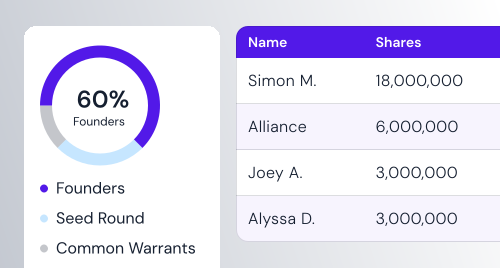
We provide a highly sophisticated cap table tool created with entrepreneurs like you in mind. Because of its user-friendly interface and advanced programming, Eqvista makes it simple to track and manage the shares of your company. You just need to create your company profile and utilize the app to issue shares electronically.
Start Managing Your Equity with Eqvista
Build your cap table, manage equity, and keep ownership organized as your company grows.