Raman Korneu on myTU’s Next Growth Phase: Scaling Payments, Securing Financing, and Expanding Across Europe

Raman Korneu, Co-Founder and CEO of myTU, has spent his career across banking, finance, and fintech. Since launching myTU, he has focused on building a technology-led financial platform with its own payment infrastructure and a growing presence across Europe.
In this conversation, Raman discusses what is driving myTU’s faster-than-expected growth, including the adoption of AI-powered banking tools and the expansion of its multi-rail payment capabilities. He also shares why the company is now seeking additional financing for Visa and Mastercard settlement reserves, what kind of lending partners it is looking for, and the milestones ahead, including its banking license roadmap in Latvia and continued investment in agentic AI.

Raman, can you walk us through your personal journey, where did it all begin for you as an entrepreneur and what drew you specifically toward financial services?
My background is banking-heavy, to put it lightly. Prior to founding myTU, I spent about 25 years in different roles in establishment finance. I also worked at Ernst & Young and PwC, where I worked in banking and capital markets advisory on 100-plus projects for major institutions like Merrill Lynch Securities and Raiffeisenbank. There was never a moment when banking wasn’t in the picture.
Many fintech founders have backgrounds in either technology or banking. Which background do you relate to more, and how has it influenced how you built myTU from the start?
I left traditional finance for a strategist role at a fintech company focused on consumer lending, and I was about to finish my EMBA at Judge Business School at Cambridge. I had a new perspective on the pain points in the industry, and seeing fintech from the inside convinced me that I could address some of those problems myself. I brought my ideas to an expert software engineer Tomas Navickas. He made me realize that we had a wealth of new technologies at our disposal. If we used them correctly, we could fix banking and make something like myTU work. Long story short, that’s exactly what we did.
myTU is a fully licensed Electronic Money Institution in Europe, which is no small feat. Regulatory licensing is often cited as one of the most severe parts of building a fintech. What was that process like, and what would you tell a first-time fintech founder who’s about to enter that journey?
It is definitely a marathon, not a sprint. We are EMI licensed by the Bank of Lithuania, and while they are incredibly supportive of innovation, their barrier to entry is high – as it should be. We operate under EU passporting rules, which means our standards for AML, KYC, and data protection must be top-tier across the entire Eurozone.
The process itself is a deep dive into every corner of your vision. You aren’t just selling a product to the regulator; you are proving that your internal controls, capital reserves, and IT infrastructure is “bulletproof”. It involves months of rigorous audits, ”fit and proper” assessments of your leadership, and demonstrating that you can integrate with third parties without sacrificing security or user consent.
If I were speaking to a first-time founder standing at the starting line, I’d give them three pieces of advice: Don’t treat regulation as a “legal hurdle” to clear at the end. Build it into your code from day one. If your architecture isn’t designed for automated reporting and data sovereignty, you’ll find yourself rebuilding the entire engine mid-application.
You need a Chief Compliance Officer who speaks the regulator’s language fluently. This isn’t a role for a generalist – you need someone who understands the nuances of risk management and can build a culture of integrity before the first euro even moves through your system.
Be proactive with the regulator. They value transparency over perfection. If you’re honest about your technical challenges and show a clear roadmap for mitigation, you build the trust necessary to secure that license.
Becoming a Principal Member of both Visa and Mastercard for issuing and acquiring, including Visa Direct and Mastercard Cross-Border Services, is rare for a company of your age. Could you walk us through how you sequenced those partnerships and what doors they opened?
You’re right – it is a massive undertaking. Most fintechs start by “renting” infrastructure from a middleman (a Banking-as-a-Service provider) because it’s faster. But we chose the harder path of Principal Membership early on because we wanted full control over our unit economics and the user experience.
We didn’t try to do everything on day 1. We followed a logical progression. We started in 2023 with card issuing to get our cards into users pockets. This established our core brand presence and basic utility. 2025 was our “breakout “year. We secured direct Visa and Mastercard Acquiring, alongside Visa Direct and Mastercard Cross-Border Services. This wasn’t just a technical upgrade; it was the acquisition of our own “financial rails”. By moving away from intermediaries, we gained the autonomy and the unit margins of a tier-one institution.
We are no longer beholden to the roadmap or the risk appetite of a sponsor bank. We sit at the table directly with Visa and Mastercard. If we want to innovate, we just build it. By stripping out the middleman that most fintechs pay, we’ve gained a level of cost-efficiency that allows us to compete with the biggest banks in Europe while staying lean and agile. Integrating Visa Direct and Mastercard Cross-Border means we aren’t just moving money; we are moving it at the speed of the modern internet. We can offer near-instant payouts and global transfers that legacy systems simply can’t touch.

European financial regulation is constantly evolving. As a regulated EMI with full Visa and Mastercard principal membership, do you see regulation as a competitive moat or as a constant operational tax? What do you think about that balance?
It’s a bit of both, but if you’re playing the long game like we are, it is undeniably a competitive moat. Let’s be honest: the “tax” is real. Staying compliant with evolving frameworks like PSD3, PSR, and Instant Payment Regulations requires significant capital, legal expertise, and constant technical updates. For a smaller or less prepared company, this “tax” can be paralyzing – it consumes their entire roadmap just to stay standing.
However, because we’ve already secured our EMI license and Principal Memberships with Visa and Mastercard, that “tax” becomes an entry barrier for everyone else. In a world of “fatigue”, being a fully regulated entity is a massive differentiator. Regulation is the proof that we aren’t just an app but a robust financial institution. That trust allows us to win larger enterprise clients and retain users who are increasingly wary of “unlicensed” players.
Many of our competitors rely on third-party banking-as-a-service providers. As regulations tighten, those middleman providers get squeezed, and their “tenants” (the fintechs) suffer from service interruptions or increased costs. Because we own our own rails, we handle our own compliance. We aren’t waiting for someone else’s legal department to give us permission to innovate.
By embracing high standards now – especially around AML and KYC – we are building a scalable foundation. When new regulations arrive, it’s usually just a “software update” for us, whereas for others, it requires a fundamental pivot of their business model.
You closed a €10M Series A in February 2025 at a €35M post-money valuation. Since then, you’ve doubled revenue and are growing month-over-month. From a founder’s perspective, what operationally changed the moment that Series A capital hit the account? What did you prioritize first?
We didn’t see that €10M as a prize; we saw it as fuel for the “financial rails” we had just finished building. Since we secured our direct Visa and Mastercard Acquiring and Cross-Border services in 2025, our first priority was putting that infrastructure to work. We didn’t just want to have the rails; we wanted to be the busiest train on them. We funneled capital into B2B customer acquisition to capitalize on our superior margins.
With revenue doubling, the manual load of AML and KYC could have easily choked our growth. We prioritized investing in AI-driven compliance automation. We wanted to ensure that as we doubled our user base, we didn’t have to double our headcount at the same rate. This is how you protect your post-money valuation – by proving the business is truly Scalable. With the Series A backing, we moved from being a “Lithuanian fintech” to a “European powerhouse”. We used the capital to fuel our marketing and localization efforts across key EU markets, utilizing our passporting rights to their full potential.
Eqvista’s Real-Time Company Valuation®, which continuously tracks live company metrics and market comparables, is currently valuing myTU at over $100M USD roughly €87M and climbing. How useful is real-time valuation visibility for a founder scaling this quickly, especially between fundraising events? Has having an independent, data-driven valuation signal changed how you communicate with your board or incoming Series B investors?
When you’re doubling revenue and growing MoM like we are, a valuation from 6 months ago is ancient history. Real-time visibility allows us to see exactly how our operational wins – like securing our direct Visa/Mastercard acquiring rails – translate into enterprise value immediately. It tells us if we are building “efficient” growth or just “expensive” growth. If our valuation is climbing faster than our burn, we know our strategy is working.
Yes, it has fundamentally changed my conversations with the Board. Instead of debating abstract concepts, we look at the independent, data-driven signal.
For incoming investors, this is a real trust-builder. Usually, a founder walks into a room and makes a claim about their value and then the investor spends weeks trying to disprove it. Now, they can see that our $100M+ valuation isn’t a number we pulled out of thin air – it’s a reflection of live market comparables and our actual performance on the ground.

Eqvista Real-Time Company Valuation® myTU valued at $112M
Traditional company valuations don’t change often, but real-time valuations are making things more dynamic. They let founders, investors, and boards see value creation as it happens. As someone who’s growing at this pace, how important is it to you to have a continuous, data-driven picture of where your company stands between funding rounds?
Relying on a valuation from a year ago is like trying to navigate a high-speed jet using a map from the 19th century.
When you have a real-time valuation signal, you can see the ROI of your strategic pivots in days, not years. It gives us the confidence to double down on what works and pivot away from what doesn’t, without waiting for the next “round” to tell us if we’re right.
Valuation isn’t just a number for investors – it’s a big driver for employee morale and retention. Our team owns a piece of this company. When they can see that their hard work – shipping a new feature or closing a major partner – is increasing the value of their equity in real-time, it creates a powerful sense of ownership.
Founders usually have to spend 6-8 months every year “fundraising mode” trying to justify a jump in value. With a continuous, data-driven picture, you are always “audit-ready”. You don’t have to scramble to build a narrative because the narrative is being built every day by the data.
How are you managing cap table, option pool, and dilution negotiations in real time, and what role does having live valuation visibility play in keeping those conversations Grounded?
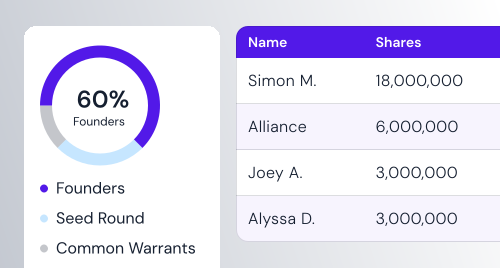
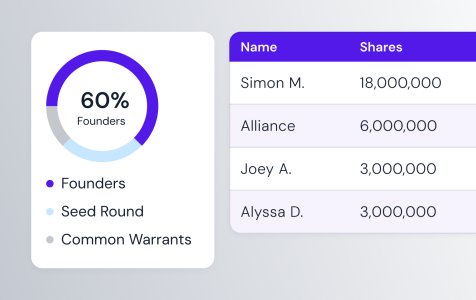
At myTU, we manage our cap table through a framework of strict regulatory compliance and public transparency. As an EU EMI, any investor seeking a stake of 10% or more must be formally approved by the Bank of Lithuania, making the integrity of our ownership records a primary governance priority. To maintain this, our cap table is managed by specialized holding company accountants and legal counsel, with the official structure always accessible via the UK Companies House. This ensures that all stakeholders – and regulators – have a “single source of truth” that remains indisputable during any round of funding.
To streamline our equity issuance and mitigate constant dilution friction, we primarily utilize Convertible Loan Agreements. We synchronize the conversion of these instruments every one to two years, typically aligning with the Bank of Lithuania’s approval windows for new major investors. During these conversion events, we also trigger our option pools: key team members hold non-delutable options up to a specific threshold, while every employee with over a year of tenure receives salary share options. This structured approach allows us to reward our team and clear our debt-to-equity obligations in a single, organized movement.
When it comes to real-time negotiations, having live valuation visibility is essential for keeping conversations grounded in data rather than speculation. Some of our existing investors have special ”top-up” terms that grant them a 5-10% discount on new round share prices, and a visible valuation provides them with immediate comfort regarding their ROI. For new investors, this transparency establishes a clear share price assumption from the outset. By providing a real-time view of our worth, we eliminate the “valuation gap” often found in early-stage negotiations, ensuring that all parties move forward with confidence and a clear understanding of the company’s trajectory.
What has driven this faster-than-expected growth, and what does reaching this milestone mean for the company?
Our growth has been primarily propelled by the rapid adoption of AI agents embedded directly within our banking platform and the expansion of our multi-rail payment capabilities. By streamlining onboarding and delivering automated, real-time transaction processing, transaction velocity scaled significantly faster than initially modeled.
Strategically, two key growth engines drove this milestone:
- The “Second Bank” Advantage: We captured a high-demand niche as the most convenient secondary account for everyday digital life. Traditional banks often create friction around dynamic use cases, whereas myTU has become the preferred choice for travel, side income, purchasing crypto, and online betting/gaming entertainment, as well as serving unbanked and underserved segments such as migrants and freelancers.
- Card-as-a-Service (CaaS) B2B Expansion: We recently rolled out our Card-as-a-Service solution in partnership with one of the largest fuel card providers in the EU, issuing business cards to truck drivers. This partnership alone represents an addressable pipeline of up to 250,000 cards, creating an immediate, high-volume recurring flow across European transport corridors.
Hitting our December Visa volume targets five months ahead of schedule validates both market positioning and technical scalability, proving our cloud-native infrastructure can seamlessly process institutional-grade volume without proportional operational overhead.
What kind of lenders or financing partners are you looking for, and what would make a strong fit for myTU?
Because this facility is specifically earmarked for our Visa and Mastercard settlement reserves rather than a speculative runway, it is tied directly to performing transaction flows. We are looking for private credit funds, fintech debt funds, or institutional credit partners experienced in revolving credit facilities or asset-backed structures for payment operations. A strong fit is a partner who understands transaction flow economics, values capital efficiency, and can provide a transparent debt facility (in EUR or USD) of up to €5 million to support our continued volume expansion by the end of 2026 and additional €5 in the beginning of 2027.
Looking ahead to the end of the year and beyond, what are the key milestones or priorities you’re focused on next for myTU?
Our immediate operational focus is finalizing the reserve financing facility by year-end to keep pace with accelerating transaction volume. Beyond that, our major strategic priority is progressing through our specialized banking license roadmap in Latvia, which will significantly broaden our operational scope across the European market. In parallel, we are continuing to advance our agentic AI capabilities embedded directly within our core banking engine, automating complex operational, risk, and compliance workflows to maintain lean margins as transaction scale continues to multiply.
For founders in fintech who are watching you move from EMI to near-bank status while raising at higher and higher valuations, what’s the one thing you wish someone had told you at the very beginning that you had to learn the hard way?
In the early days of fintech, there was a huge temptation to take shortcuts. Everyone tells you to use a “sponsor bank” to “white-label” your technology, and to rent someone else’s license. They tell you it’s the only way to move fast.
We learned the hard way that when you rent any part of your infrastructure, you are also renting your future. You are at the mercy of someone else’s compliance department, someone else’s technical downtime, and someone else’s margins.
Own your rails, own your license, and own your destiny. It’s the hardest way to start, but It’s the only way to win.