409A Valuation vs Fair Market Value (FMV): What’s the Difference?
Understand how Fair Market Value and 409A valuations differ, how they are connected, and when each type of valuation is needed.

FMV and 409A are related, but they are not the same thing. Understanding the difference enables agile, informed decision-making on startup equity and tax planning.
FMV is the price an asset could sell for between willing, knowledgeable parties in an open market. A 409A valuation is an appraisal used to determine the FMV of a private company’s common stock for Section 409A purposes. The FMV definition can be applied to other share classes and securities, but then it won’t be a 409A valuation.
In this article, we’ll explain how 409A and FMV connect, why valuations differ, and when each type of valuation is needed.
What is Fair Market Value (FMV)?
Fair market value (FMV) is not a specific valuation product or report. Rather, it is a set of assumptions or controls. When you calculate the FMV, you must assume that the asset is being sold willingly in an open market between knowledgeable parties.
In the context of 409A valuations, this asset is the common stock. The FMV definition is also applied to assets and liabilities exchanged as part of an M&A transaction and in gift and estate valuations.
What Goes Into Each Type of Report
Every valuation report you read will disclose the purpose and scope of engagement, capital structure, financial analysis, industry analysis, appraiser certification, and the valuation methodology and assumptions. The purpose of valuation will influence which other elements are included in the report.

- 409A valuation: Equity allocation across share classes, explanations regarding the applicable discount for lack of marketability (DLOM), and FMV of the common stock (per share basis)
- Gift and estate valuation: Discussion regarding the specific interest being transferred, tax-related analysis, explanations regarding the applicable discount for lack of marketability (DLOM) and discount for lack of control (DLOC), and the appropriate IRS disclosures
- ESOP valuation: Level of value and control analysis, a repurchase obligation study, and a fairness opinion to the trustee
- M&A/Investment valuation: Deal context, discussion regarding synergies, comparable precedent transactions analysis, financial projections, and fairness opinion
The core valuation principles may overlap, but the valuation’s purpose determines the analysis, assumptions, and final report.
What is a 409A Valuation?
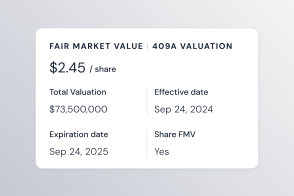
A 409A valuation is an appraisal meant to determine the FMV share price of your company’s common stock. Its primary purpose is to ensure compliance with Section 409A. The right 409A valuation will help you secure safe harbor protection, which places the burden of proof on the IRS in case of audits. These protections are valid for 12 months or until a material event occurs, whichever is sooner.
409A valuations also help companies build a strike price strategy.
When you set the strike price equal to the FMV or higher, the option holder will not recognize income upon exercise. From an employee’s perspective, this is a huge plus since owing taxes before the stock is sold can be problematic for employees who don’t have cash savings they can spare.
That’s one example of a strike price strategy.
A 409A is a compliance-focused valuation, while other valuations may serve different purposes. For example, a financing valuation reflects a negotiated price for preferred stock and may differ from the common-stock FMV determined in a 409A.
Even when 409A valuations and funding valuations both comply with the FMV rules, they can mean completely different amounts. Why? Because a 409A valuation is the lowest defensible FMV of the common stock, while the funding valuation would be the highest plausible FMV of the preferred stock.
409A vs Fair Market Value: What’s the Difference?
FMV is the end product. 409A valuation is the process used when the FMV of common stock must be calculated to comply with Section 409A’s requirements. Let’s dive deeper into the difference between 409A valuations and FMV.
| Fair market value (FMV) | 409A valuation | |
|---|---|---|
| What is it? | A standard of value | Valuation performed to comply with Section 409A of the IRC |
| What does it determine? | Depends on the assets being valued | FMV of the common stock |
| Primary purpose | Depends on the assets being valued | Issuing stock-based compensation in a tax-compliant manner |
| Typical users | Businesses, investors, tax advisers, estates and others | Companies issuing equity compensation |
| Subject being valued | Business, shares, ownership interests, securities, or other assets | Common stock |
| Methodology | Depends on the assets being valued | Value allocation preceded by accepted business valuation techniques |
| Compliance framework | Depends on the assets being valued | IRC Section 409A and related Treasury regulations |
| Output | Depends on the assets being valued | Typically, a valuation report containing the common stock FMV per share |
| Refresh | Depends on the assets being valued | Generally annually or after material events |
Still wondering how FMV and a 409A valuation differ? The visual below breaks down their purpose, scope, methodology, and common uses, so you can quickly see which valuation type applies to your situation.
Key takeaway: FMV is a broader value standard that can apply to different assets and transactions. A 409A valuation is a specific valuation focused on determining the FMV of a private company’s common stock for equity compensation and Section 409A compliance.
How is FMV Determined in a 409A Valuation?
In a 409A valuation, the analyst will start by determining the company’s valuation and then allocate this value across the securities issued by the company to arrive at the FMV of the common stock.
Typically, analysts use business valuation techniques that fall under the market, income, or asset approaches, or a combination of the three. Then, the value is allocated across all securities issued by the company based on OPM, PWERM, or the hybrid method, whichever is appropriate.
In this analysis, the analyst will consider the company’s performance, capital structure, recent financing activity, and stage, along with external factors.
When Do You Need a 409A vs Another Type of Valuation?
409A valuations are meant to determine the FMV of a company’s common stock using IRS-accepted methodologies for issuing stock-based compensation. However, such a valuation fails to capture the subjective benefits that either party stands to gain. Hence, a different form of valuation is considered for M&A transactions.
Here’s how you can choose the right valuation for your situation:
| Situation | Valuation type |
|---|---|
| Issuing employee stock options | 409A valuation |
| New funding round | Preferred share valuation |
| M&A | Business/M&A valuation |
| Gift & estate planning | Gift & estate valuation |
| ASC 718 reporting | Fair value analysis for stock-based compensation |
| ESOP transactions | Independent ESOP valuation |
FAQs
Is a 409A valuation the same as FMV?
No. FMV is a standard of value that states certain assumptions or controls to be set when determining an asset’s valuation. A 409A valuation is an appraisal that determines the FMV of a company’s common stock as per Section 409A.
Why is 409A FMV different from the preferred share price?
When the 409A FMV focuses on common stock valuation, as it typically does, the 409A FMV per share is bound to differ from the preferred share price.
Is 409A FMV the same as the option strike price?
Not necessarily. The option strike price can be set equal to the FMV or higher. This will mean that you do not recognize income upon exercise and do not immediately owe taxes. Eventually, when you sell these shares, you will owe taxes on your gain.
Why is my 409A valuation lower than my funding valuation?
Funding valuations can exceed 409A valuations for various reasons. A common reason is that 409A valuations typically value common stock, and funding valuations are preferred stock valuations.
Can I use a 409A valuation for fundraising?
No, you cannot use a 409A valuation for fundraising. Doing so may mean selling preferred shares at the common stock price, which can represent a significant discount.
How long is a 409A valuation valid?
A 409A valuation is valid for 12 months or until a material event occurs, whichever is sooner.
Do I need a new 409A after a funding round?
Yes, a funding round is seen as a material event, and hence, it creates the need for a fresh 409A valuation.
How Eqvista Helps Determine 409A Fair Market Value
Eqvista enables private companies to confidently leverage stock-based compensation to attract talent while keeping cash outflows in check. Our 409A valuations are delivered by a versatile and experienced team of NACVA-certified valuation professionals. Our detailed reports and lifetime audit support ensure that founders are not caught off guard in IRS audits.
To get started or speak with our valuation team, contact us now!
Get the Right Valuation for Your Company
Whether you need a 409A or fair market valuation, Eqvista’s in-house team can help.