Whenever an investing entity encounters an opportunity that is just too attractive to miss but exceeds the capacity of its primary fund, a sidecar investing structure becomes indispensable. Setting up the framework correctly ensures that everyone benefits without any future complications.
A sidecar investment agreement should be simple, clear and tightly aligned with the main deal, because the real challenge is not setting up the vehicle, but making sure the economics, control and exit terms work cleanly for everyone involved.

What Is Sidecar Investment?
Sidecar investments refer to a type of co-investment structure that involves external investors placing money together with a lead investor, usually a venture capital firm or private equity fund, into one particular deal. As opposed to conventional funds, the sidecar targets one deal or a small number of deals rather than a whole pool of deals.
The SPV (Special Purpose Vehicle) is the most popular format for sidecars, and it exists in two forms, which are either an LLC or a limited partnership. With SPVs, all the funds get pooled together, and all parties involved have limited liabilities. The SPV invests in conjunction with the parent fund, thus making co-investors indirect shareholders in the target company’s stock.
The Core Parties Involved
Every sidecar agreement involves three distinct roles, each carrying specific responsibilities:
- Sponsor/Lead Investor – The private equity or VC firm that identifies the deal, performs due diligence, negotiates terms, and manages the investment process
- Co-Investors – Institutional investors, family offices, or high-net-worth individuals who provide additional capital and may conduct their own analysis to verify alignment with their financial goals
- Management/Operator – Oversees the operational execution of the investment, maintains financial records, ensures regulatory compliance, and manages cash flows
Understanding these roles before drafting the agreement prevents governance conflicts down the line.
Key Clauses To Include In The Agreement
A well-drafted sidecar agreement covers several critical areas. Here is what each clause must address:
Investment Objectives and Trigger Events
State clearly the investment opportunity or asset in which the sidecar will participate. Include the “trigger event” that would initiate the sidecar investment, such as the lead investor making a certain threshold investment amount (for example, $50,000 by the lead group). State how the sidecar will make its investment commitment, either through a pre-set commitment level or flexibly based on the lead investor’s commitment.
Capital Commitments and Contributions Timeline
Detail the amount committed by each co-investor, the overall sidecar capitalization, and contribution timelines. Determine if the commitment is a single lump sum or call in tranches, and the consequences if an investor fails to contribute.
Governance and Voting Rights
Establish the governance structure. Sidecars typically give the lead investor primary governance powers, with secondary voting rights for co-investors. Veto powers over specific events, such as selling the firm or issuing stock, can be agreed upon at this point.
Distribution Waterfall
List the sequence of distributions. In most arrangements, the usual waterfall is starting by distributing preferred return to investors, followed by splitting carried interest among the sponsor. Clearly state any form of liquidation preference (participating or non-participating), as failure to define will cause conflicts in the exit process.
Anti-Dilution Provisions
In case the portfolio company issues stocks at a lower value in subsequent rounds, anti-dilution provisions will prevent dilution for co-investors. These provisions include either full ratchet (reducing conversion price to the new lower price) or weighted average (average of the two stock prices).
Transfer Restriction & Tag/Tag-Along Rights
Restrain co-investors from transferring their stakes freely. If the lead investor opts to transfer, tag along rights will ensure that minority co-investors are forced to do the same. Drag-along provision enables the lead investor to force co-investors to participate in sales when the transaction involves majority shareholders.
Exit Strategy and Timeframe
Establish the planned mode of exiting, such as through direct sale, IPO, or recapitalization, and determine the holding period, which ranges from three to seven years in PE. Sidecar investments provide greater flexibility in terms of exit strategies compared to syndicated investments, since timelines can be adjusted according to market conditions.
Regulatory Requirements
Sidecar investments set up as private placements must adhere to regulations stipulated in SEC Regulation D in the United States. The sponsor must ascertain whether or not the other party is an accredited investor, while both must fulfill AML/KYC guidelines mandated by FinCEN.
Tax Issues You Must Not Overlook
The selection of a business structure impacts tax implications. LLCs and LPs have pass-through tax benefits where the income or losses get passed on to the investors without entity-level taxation. On the other hand, corporations will experience double taxation since there is taxation at the corporate level and later, after dividend distribution.

The timing of exit decisions plays a critical role in tax considerations. In the United States, investments held for more than one year enjoy the long-term capital gains rate, which is considerably lower compared to ordinary income tax. Additionally, participants in sidecar funds that invest in real estate can consider utilizing section 1031 exchanges.

How Eqvista Supports Sidecar Structuring
It goes without saying that having the right documents in place to structure your sidecar financing does not suffice. At each stage of your investment journey, from entering the agreement through profit distribution and exit strategies, valuations are crucial.
Eqvista facilitates this process by offering equity management services, including managing your cap table and conducting robust 409A valuations to meet your needs.
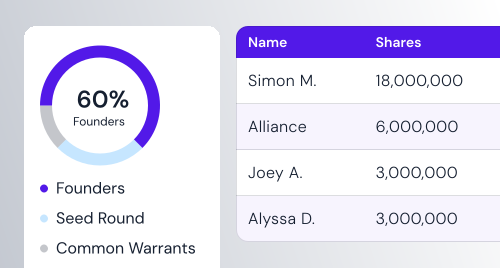
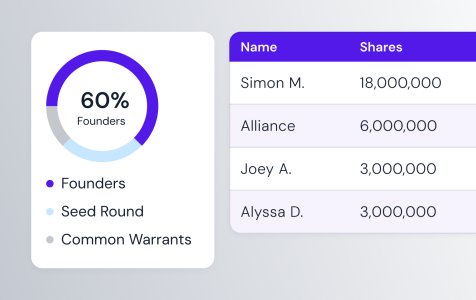
Sidecar funding models have diverse equity arrangements, and different share classes, convertibles, and stacked preferences might come into play. Having a properly managed cap table ensures there is no confusion during negotiations and audits.
Learn more about cap table management at Eqvista
Ready to structure your sidecar investment with a clear cap table and accurate valuations?