How Founders Can Get the Most Value from Series A Capital?
In this article, we will discuss cost management and capital deployment strategies that maximize the impact of your Series A funds.
Series A is not a finish line. It is a launch ramp. The companies that become category leaders do not simply raise more money than their competitors, but they do deploy it smarter.
Yet most founders focus on how much to raise instead of thinking about how to spend. This distinction matters a lot.
For instance, FTX US raised the 8th largest Series A round in history ($400 million in 2022), yet filed for bankruptcy in the same year due to mismanagement of funds and a liquidity crisis.

Treat Capital as a Multiplier, Not a Budget
Most founders approach Series A capital like a household budget. They allocate it across departments, track spending, and report to investors. This is necessary, but it is not sufficient.
The founders who extract the most value from their raise treat capital as a multiplier. Every dollar deployed should generate more than a dollar of enterprise value. That reframing shifts every decision from ‘can we afford this?’ to ‘does this add value?’
Another way to think about this is dividing every potential cash outflow into the categories of consumable costs and compounding investments. Rent for larger offices, for instance, is largely consumable.
In contrast, expenses that lead to the creation of a proprietary dataset, a dominant position in a high-value customer segment, or a deeply embedded distribution partnership are compounding investments. Series A capital should be disproportionately directed at the latter.
Use Equity Compensation to Extend Runway Without Sacrificing Talent
Equity compensation is not just a recruiting tool. It is a cash flow management instrument.
Consider a senior engineer at market rate. Offering a blend of below-market salary and meaningful equity reduces monthly cash burn while still attracting top talent who believe in the company’s trajectory. This approach can realistically reduce annual salary expenditure by 15-25%, which can instead fund product or distribution channel development.
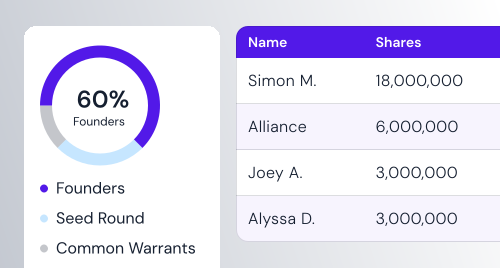
But you must note that equity compensation only works when employees understand and trust the value of what they are receiving. That requires a well-maintained cap table, transparent ownership tracking, and timely 409A valuations that reflect the company’s current fair market value.
Companies that treat equity administration as an afterthought often underutilize equity. Employees underestimate the value of unclear or mismanaged equity compensation plans and demand higher cash compensation instead.
With the right tools and sufficient employee education, equity compensation creates alignment between your team and your investors that most cash compensation structures can replicate.
Deploy Capital in Tranches Tied to Milestones, Not Time
One of the most expensive post-Series A mistakes is spending in a straight line. Founders raise funds and mentally divide them by 24 months to create a fixed monthly budget. This builds a false sense of security and actively discourages the bold bets that Series A capital is designed to fund.
A more effective approach is milestone-based deployment. Before spending begins, define two or three pivotal milestones, such as a specific ARR threshold, a product launch, or a market penetration target. Then, allocate tranches of capital to each milestone rather than to time periods.
This does two things. Firstly, it forces prioritization, since resources are explicitly tied to outcomes. Secondly, it preserves flexibility. If the first milestone is achieved ahead of schedule, the capital earmarked for that phase can be redeployed towards the next milestone. In case the first milestone is not achieved, you still have enough runway to identify the problem.
Reverse-Engineer Your Series B Targets Before You Spend a Dollar
Sophisticated founders do not plan their Series A spending in isolation. They start by asking the question their Series B investors will eventually ask, and they work backwards.
This means identifying the two or three metrics that will most credibly signal product-market fit and scalability to a future investor. These metrics could be some combination of revenue growth rate, net revenue retention, and unit economics.
Once those metrics are defined, every material spending decision should be filtered through a single question: ‘Does this accelerate our ability to demonstrate these numbers?’
This reverse-engineering exercise consistently reveals misallocation.
Leverage Your Investor Portfolio as a Distribution Channel
Most founders understand that investors bring more than capital. Few actively exploit it. Your lead investor’s portfolio is a curated list of companies that already trust your investor’s judgment, operate in adjacent spaces, and are open to strategic partnerships. This is a distribution channel hiding in plain sight.
Companies that leverage investor networks for commercial introductions can achieve customer acquisition costs that are a fraction of those relying purely on outbound sales. Before building any new go-to-market function from scratch, map your lead investor’s portfolio and directly ask which portfolio companies could become your first 10 enterprise customers.
Eqvista – Where Smart Capital Meets Smarter Equity Management!
Series A capital is finite. The founders who extract disproportionate value from it share one characteristic. They treat every dollar as a strategic decision rather than a routine expense. From using equity compensation to manage burn to reverse-engineering Series B expectations before the first dollar is spent, the edge lies in disciplined, intentional deployment.
But none of these strategies fully work if your equity infrastructure cannot keep pace with your ambitions. A mismanaged cap table erodes the employee trust that makes equity compensation effective. Inaccurate or stale valuations distort the financial picture you rely on to make capital deployment decisions. The result is a compounding problem. The very tools designed to stretch your runway end up undermining it.
Eqvista’s cap table management platform gives post-Series A founders the infrastructure to turn equity into a genuine strategic asset, with real-time 409A valuations, automated vesting tracking, and audit-ready documentation built in from day one.
Contact Eqvista today to ensure your equity works as hard as your capital does!
Interested in issuing & managing shares?
If you want to start issuing and managing shares, Try out our Eqvista App, it is free and all online!