How to Get Your Startup Ready for Private Equity Funding (Complete Guide)
Learn how to prepare your startup for private equity funding and long-term growth.
Private equity funding is capital raised from institutional investors and deployed to acquire controlling or significant ownership positions in private companies, often using a combination of equity and debt, to improve performance and create value before exit.
According to McKinsey’s 2025 Global Private Markets Report, global private equity deal value rebounded in 2024, rising approximately 18% compared to 2023, signaling a meaningful recovery after two years of subdued activity. For founders, private equity funding means more capital is available, but only for companies that can show clean numbers, clear ownership, and a credible growth story.
This guide explains how to get your startup ready, step by step, from strategy and financials to cap table governance, and due diligence.
What does private equity funding mean for startups?
Private equity financing is distinct from seed investments into startups. Private equity typically involves acquiring controlling or significant ownership positions in companies that have traction, generate income and are scalable. An investor’s aim here is to enhance their operation and subsequently exit via an IPO or by selling the firm.
With startups, private equity is not about funding ideas but businesses that are already generating some value and are capable of growing to higher levels of value when provided with proper funding and support. This is why investors analyze such factors as margins, recurring revenue, concentration of customers, and cash flows.
Private Equity Vs. Venture Capital: Key Differences
| Aspect | Venture Capital | Private Equity |
|---|---|---|
| Ownership stake | Minority ownership positions | Controlling/majority ownership positions |
| Target companies | Early-stage/unproven businesses | Traction + proven revenue model |
| Capital structure | Equity only | Equity + debt (leverage) |
| Involvement | Passive capital provider | Active operational involvement |
| Use of funds | Funds ideas & early growth | Funds growth, acquisitions, operations |
| Exit routes | IPO or acquisition | IPO, strategic sale, or secondary buyout |
How to know if your startup is ready for Funding?
A startup is more likely to be ready for private equity if it has predictable revenue, stable operations, a credible management team, and disciplined internal reporting. A practical benchmark is that many lower-middle-market PE buyers start screening around $1M-$3M EBITDA, with stronger interest often in the $3M-$10M EBITDA range; for software and recurring-revenue companies, PE buyers often look at $3M+ ARR, with the buyer pool widening further at $5M+ ARR. PE investment thresholds still vary by fund size, sector, and deal strategy, so the key signal is not one fixed number but whether the business has repeatable, defensible revenue and durable cash flow.
Investors want to see that the business can use capital efficiently and that growth is not dependent on unsustainable spending. If you struggle to produce consistent monthly financials, cannot clearly explain your unit economics, or rely on ad‑hoc reports, it is usually better to fix those gaps before launching a private equity process.
It is also necessary to consider if your company can handle the added level of governance that will come with a private equity deal. Typically, with private equity, there comes board governance, reporting, and strategic participation.
What private equity investors look for before funding?
See your company through an investor’s eyes across business model, financial quality, operations, and governance, and understand what really drives a yes or no in investment committees.
Business quality
Private equity investors want to see a clear business model, a defensible market position, and evidence that the company can grow without losing control of margins. They pay close attention to customer concentration, pricing power, retention, and revenue durability. A business that depends heavily on a few customers or cannot maintain pricing is riskier from their perspective.
Financial quality
Investors will look at whether your figures are internally consistent, properly reconciled and logically supported. Your figures in regard to revenue growth, gross margin, EBITDA, cash flow, and working capital will be considered. If your business model uses recurring revenues, figures like ARR, MRR, churn, retention, and LTV/CAC will get extra attention.
Operational quality
They want to know whether the company can scale. That includes systems, reporting cadence, team structure, and the ability to manage growth without breaking internal processes. Investors look for reliable financial systems, basic automation, and a leadership team that can handle a larger organization.
Governance and documentation quality
Private equity investors also analyze decision-making processes, ownership documentation, and the history of the corporation’s records. Incomplete documentation, inadequate board approval, or sloppy corporate record-keeping may delay or jeopardize the process of selling a business to private equity.
How To Build a PE Ready Growth Story?
Turn your strategy into a concise, credible growth narrative that connects today’s performance to tomorrow’s upside and shows exactly how new capital will create value.

Explain where the business is now
Before you pitch private equity investors, you should be able to summarize your current revenue, core customer segment, channels, and key performance metrics in a few clear sentences.
A strong growth story should answer four questions:
- Why is now the right time?
- What problem does the business solve?
- What specific growth levers will capital unlock?
- How will that growth translate into value?
Investors want to see a direct line from new capital to revenue growth, margin improvement, or strategic advantages.McKinsey notes that in today’s environment, “private equity firms are focusing more on targeted value‑creation plans than on broad multiple expansion,” which means your plan must show how execution drives returns.
Get your finances ready
Financial readiness is one of the most important parts of private equity preparation. Investors need to trust the numbers before they trust the story. Start by organizing historical financial statements in a consistent format. Income statements, balance sheets, and cash flow statements should be complete, accurate, and reconciled to your general ledger.
Advisory guides on investor due diligence consistently stress that incomplete or inconsistent financials are a leading cause of delays or renegotiations in deals.
Prepare a forward‑looking model
Next, prepare a forward‑looking model that connects to actual performance. Your forecast should not look disconnected from reality. It should show how revenue grows, how margins move, what costs scale with growth, and where additional capital will be used. Investors will test your assumptions against historical trends and industry benchmarks.
Define your key metrics
You should also define your key performance metrics. For subscription businesses, that often includes ARR, MRR, churn, expansion revenue, and retention. For other startup models, it may include customer acquisition cost, payback period, gross margin, contribution margin, and operating cash burn. Having clear definitions and consistent tracking makes it easier to answer detailed questions during diligence.
Fix governance and legal gaps
Private equity investors do not just review financials. They also review the company’s legal and governance foundation. Make sure your corporate records are complete. That includes incorporation documents, shareholder approvals, board minutes, stock issuance records, and any amendments to company documents.
Check contracts and IP ownership
You should also review contracts, IP ownership, employment agreements, and any regulatory obligations. Founders and contractors should have properly assigned intellectual property. Key customer and supplier agreements should be reviewed for change‑of‑control clauses or other risks.
Resolve compliance issues early
If your company operates in a regulated area, compliance issues need to be identified early. It is much easier to address legal gaps before a process starts than during investor negotiations. Guidance from tax and regulatory authorities also emphasizes the importance of maintaining records that support your reported income and positions.
Prepare a data room
A well structured data room shortens the time from initial interest to signed agreement. Your data room should include:
Strengthen your investor presentation
Your investor materials should be clear, concise, and factual. Do not overload the deck with generic statements or broad claims. Your presentation should explain:
- What the company does
- Why the market matters
- How the business makes money
- What traction it has achieved
- What growth looks like next
- How the capital will be used
Mistakes that Kills PE Deals
Learn the recurring pitfalls that slow or derail private equity deals so you can fix them in advance and walk into investor meetings with fewer risks on the table. Some mistakes come up repeatedly in private equity preparation, like:
- Weak or inconsistent financial reporting – This means the numbers do not tie out cleanly from one period to the next, so investors cannot trust the financial story.
- A messy cap table – This means ownership records are outdated or inconsistent with legal documents, which can create confusion and delay diligence.
- Unclear ownership of IP – This means the company cannot fully prove it owns the intellectual property it uses, which creates legal and valuation risk.
- Incomplete legal records – This means key board, contract, and ownership documents are missing or poorly organized, which slows review.
- Overly optimistic forecasts – This means growth assumptions are too aggressive compared with historical performance, which weakens credibility.
- A vague use‑of‑funds plan – This means the company cannot clearly explain how the money will be used, which makes the investment case less convincing.
- Poor data room organization – This means diligence materials are scattered or hard to navigate, which signals weak preparation.
- Inability to explain KPIs clearly – This means the company cannot define or defend its core metrics, which makes investor underwriting harder.
These problems are avoidable. The earlier you fix them, the easier it becomes to run a credible process. Cleaning up your financials, equity records, and corporate documentation before approaching investors signals professionalism and reduces the risk of last‑minute surprises.
PE Readiness Checklist
Private Equity readiness starts with equity readiness.
- Organized 3-year historical financials – Complete, auditable financial statements for three years’ income statements, balance sheets, and cash flow that tie out cleanly and follow consistent accounting. PE firms need clean financials because inconsistent reporting makes numbers untrustworthy during diligence
- Clean, updated cap table – Ownership record that accurately reflects all equity issuances, is current with the latest transactions, and matches signed legal documents without gaps. Fragmented or outdated cap tables create dilution, confusion, and delay deal review.
- Assigned IP ownership for founders/contractors – All intellectual property has proper assignment agreements confirming the company owns it, not individual founders or contractors. Without clear IP ownership, investors face legal and valuation risk.
- Board minutes and corporate records complete – All board approvals, stock issuances, contracts, and corporate documentation are properly organized, signed, and stored for easy retrieval. Incomplete records make diligence slower and less reliable.
- Forward-looking financial model with assumptions – Detailed financial projections for 3-5 years with revenue, margins, and growth, each assumption documented and backed by historical performance. Forecasts stretched beyond what operations support can reduce investor confidence.
- Structured data room – All diligence materials are organized in a logical, searchable structure that investors can navigate efficiently. Scattered materials slow review and signal weak process discipline.
Key Terms Glossary
- EBITDA – stands for Earnings Before Interest, Taxes, Depreciation, and Amortization. A measure of a company’s core operating profitability, which is commonly used by PE investors to assess financial performance and compare companies across industries.
- Cap Table (Capitalization Table) – A record of who owns equity in a company, including founders, investors, and option holders, and the amounts of their equity.
- ARR / MRR – Annual Recurring Revenue / Monthly Recurring Revenue. Metrics used to measure predictable, subscription-based income streams.
- LTV/CAC– Lifetime Value-to-Customer Acquisition Cost ratio. Measures how efficiently a business acquires
customers relative to the long-term revenue they generate. - Change-of-Control Clause – A contract provision that is triggered when ownership of a company changes hands, potentially granting the other party the right to renegotiate or exit the agreement.
Private Equity Funding FAQs
The answers below cover the most common concerns around timing, financial requirements, cap tables, governance, and how a PE partnership changes your company so you can approach investors with more clarity and confidence.
What is the first step in preparing for private equity funding?
The first step is to evaluate your current readiness honestly. Review your financial reporting, cap table, legal documents, and internal controls, then list the gaps that would slow an investor’s due diligence. Once you see those gaps clearly, you can plan a focused cleanup before speaking to private equity firms.
Why is a clean cap table important for private equity?
A clean cap table gives investors immediate clarity on who owns what and how economics flow in different scenarios. When equity data is accurate and up to date, it becomes much easier to structure terms, model dilution, and align incentives with existing shareholders and new investors.
Do startups need audited financials for private equity?
Audited financials are not always mandatory, but they are a strong signal that your numbers can be trusted. If a full audit is not feasible yet, at least ensure your books are prepared under consistent policies, reviewed by professionals, and supported by documentation that ties back to your general ledger.
How long does private equity due diligence usually take?
Due diligence timelines vary, but many mid‑market deals take several weeks to a few months from term sheet to signing. The more organized your financials, legal records, and data room are, the shorter that timeline becomes, because investors spend less time chasing clarifications and corrections.
What happens to employees’ equity when a private equity deal closes?
In many deals, existing option holders and shareholders continue to participate in future upside, but the details depend on the structure of the transaction. Founders and employees should understand how new capital, option refreshes, and exit waterfalls affect their ownership before agreeing to terms.
Getting investor‑ready with Eqvista
Private equity investors do not fund potential. They fund proof.
They want clean numbers, clear ownership, and a growth story backed by real evidence, not spreadsheets with gaps, cap tables that do not reconcile, or corporate records that take weeks to locate. The companies that win PE funding are not always the ones with the best product. They are the ones who walked into the room fully prepared.
That preparation starts long before the first investor meeting. It starts with your equity structure.
Your cap table is the foundation of every PE conversation
When ownership is unclear, diligence stalls. When equity records are outdated, term sheets get complicated. When option pools are undocumented, investors discount your valuation.
Eqvista fixes that.
Eqvista gives founders and finance teams a single platform to manage cap tables, model equity scenarios, track option grants, and generate investor-ready ownership reports – so when a PE firm asks “who owns what and how does economics flow,” you have the answer in seconds, not days.
If you are serious about private equity, start with what investors will look at first.
- Clean your cap table
- Organize your equity records
- Model your dilution scenarios
- Generate audit-ready ownership reports
Get started with Eqvista today, and walk into your next investor meeting with confidence.
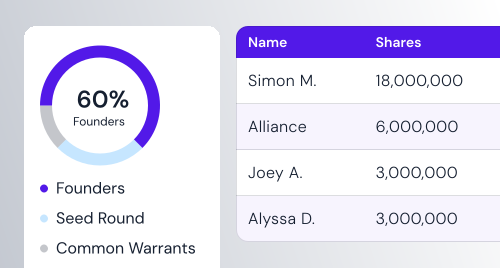
Start Managing Your Equity with Eqvista
Build your cap table, manage equity, and keep ownership organized as your company grows.