In this edition of Founder Spotlight, we talk with Albert Swantner, CEO and Co-Founder of Nameless CPG, a trailblazing Austin-based company revolutionizing the consumer packaged goods (CPG) space through strategic brand acquisitions.
Albert, a serial entrepreneur with a mechanical engineering background from the University of Texas at Austin, brings deep expertise from prior ventures such as Mobile Tech RX (acquired by Repairify) and SaveDay, now part of Verdara. At Nameless CPG, launched in late 2023 alongside co-founder Kate Herling, he’s building a powerhouse portfolio of wellness-focused brands by bringing manufacturing, logistics, and marketing in-house for greater efficiency and profitability.
Join us as Albert Swantner shares insights on navigating the post-venture funding landscape, scaling CPG roll-ups, and driving sustainable growth for founder-led brands.

What inspired you to launch Nameless CPG, specifically targeting a roll-up strategy in wellness, food, and beauty amid a cooling VC market for CPG brands?
What inspired us was seeing how many genuinely great brands were looking for a long-term home. These aren’t necessarily broken businesses, they’re often well-loved products that just aren’t on a venture-style growth trajectory.
Our focus is on taking those brands, making them profitable and operationally healthy, and then helping them grow in more sustainable, organic ways. There’s a real gap in the market for that kind of ownership model.
Nameless has acquired seven brands to date. Could you walk us through your evaluation criteria for acquisition targets? What makes you say “yes,” and what operational synergies have you unlocked post-acquisition?
We run almost every part of the operation in-house, our own 3PL and warehousing, marketing, and even some manufacturing. That gives us tighter cost control and lets us capture margin that would otherwise live with vendors.
When we evaluate a brand, we try to understand the actual size of the business without artificially fueled growth. From there, we ask whether it can hit our profitability targets within our model. And just as importantly, we have to genuinely like the brand, it needs to fit what we’re building and be something we’re excited to work on.
The CPG consolidation space has seen various players emerge with mixed results. How do you view the competitive landscape for brand aggregators, and what differentiates Nameless CPG’s approach?
The biggest difference is that we actually want to run the brands. We’re not just bolting on revenue or optimizing for an Amazon algorithm.
Profitability is core to how we operate, and we’re very focused on turning brands around quickly, often within the first 90 days, so they start contributing meaningfully to the business. That hands-on, operator mindset sets us apart.
VCs shifted to AI, leaving CPG brands starved for growth capital. How did you bootstrap operations while finding founders willing to sell equity?
Most of our early deal flow came from venture firms and financial partners who had portfolio brands they weren’t quite sure how to support next.
We used a modest amount of our own seed capital to get started, but once a brand is stabilized and generating cash, it becomes much easier to operate and grow. We also share resources across the portfolio, so when we’re pitching retail, we’re often pitching two or three brands at once, which lets us use our scale to our advantage.
Many viewed roll-ups as failure admissions, preferring traditional exits. How did you overcome skepticism around equity retention and profitability paths?
If a founder can get a 3x revenue all-cash offer, that will beat us every time. And that’s okay.
We’re focused on a different set of opportunities: companies that can’t command those premiums today but can be profitable and grow within our model. That’s where we do our best work. We’re very upfront about that, and we’re excited by situations where there’s real value to unlock through operational focus.

Nameless centralizes marketing across its portfolio. How do you unify branding for diverse products without diluting individual identities?
We centralize functions, not brands. Each brand keeps its own identity, voice, and marketing strategy.
When we do decide to sunset a brand and merge products into another line, we’re very careful. That transition takes real work, and if you’re not thoughtful, you can lose what made the original brand special. Preserving that uniqueness is something we take seriously.
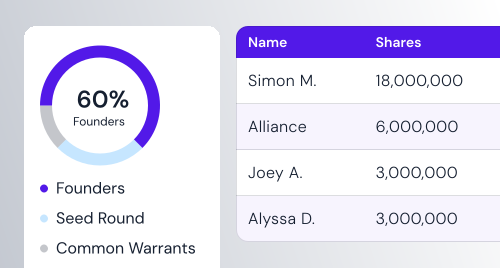
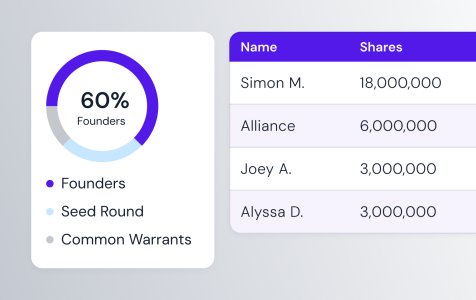
Given Nameless CPG’s structure, your cap table must be complex. How did you decide to use Eqvista, and what challenges does it solve?
We have over 100 shareholders who came in at different times and price points, and our Excel cap table was getting out of hand.
Eqvista worked well because it could handle the complexity without being overkill. They understood that cost mattered to us, we needed something simple, reliable, and accurate, not a massive enterprise system.
For founders transitioning to minority equity holders, what visibility do you provide into overall business performance?
We send a quarterly update to all equity holders where we walk through the good, the bad, and the ugly. Everyone also has access to Eqvista to see their holdings.
Beyond that, we’re always open to conversations. If an investor wants to understand what’s going on in the business, we’re happy to talk through it directly.
Reflecting on SaveDay’s sale and recognition like Austin Under 40, what personal strategies kept you resilient during high-stakes pivots?
I genuinely enjoy the work. I like solving hard problems and building alongside great co-founders and teams, and that makes the tough moments easier to push through.
Every full-time employee at Nameless has equity, so we’re all in it together. And I’m lucky to have a very supportive family that understands the ups and downs that come with entrepreneurship.
What’s the most controversial belief you hold about the CPG industry that most people would disagree with?
I think too many CPG brands chase growth before earning profitability. It doesn’t matter to me how many doors you are in. Scale doesn’t fix broken unit economics or velocity problems, it just makes these problems bigger. A slower, more disciplined approach often creates far more long-term value, even if it’s less exciting in the short term.
For founders reading this, what’s your pitch to sell to Nameless—and a key lesson on building an acquirable CPG company?
I’m always happy to talk with founders and give them an honest opinion about their business.
To sell to Nameless, you need real, proven traction and a product that a meaningful number of people genuinely want to buy. We can fix a lot of operational issues, but creating true product love is incredibly hard. That’s the part you have to get right first.