Not sure which financing or exit scenario is the best for your business? This question comes to mind for many private companies looking for financing options for their future growth. Now that companies have more liquidity and financing options at their disposal, this creates the need for more sophisticated financial scenario modeling.
Even though companies have the option to stay private for longer, it can be hard for businesses and their investors to determine the kind of funding or exit scenarios that are best for the company before they go public.
What is Financial Scenario Modeling?
Scenario analysis is the process of analyzing and assessing all possible results that can take place in the future by considering multiple feasible outcomes for a given event. In financial scenario modeling, this process is normally used to determine the variations in the value of a business or cash flow, particularly when there are both favorable and unfavorable events that can impact the company.
A lot of business managers also tend to use scenario analysis during their decision-making process to determine the best and worst case scenario while anticipating potential profits. In fact, this process is not just for companies, but for individuals as well. An individual can use this process for big lifetime expenses, like setting up a business or purchasing a house. Keep reading to know more!

Generating cases to be used in Scenario Analysis
While the executives and managers are performing the scenario analysis in the company, they will also look at the different statistics of the economy, the industry, and the business. All these stats would give various scenarios, which would include assumptions such as interest rates, inflation, operating costs, customer metrics, product prices, and other business drivers.
The managers usually begin with 3 basic scenarios:
- Base-case scenario: Based on management assumptions, this is the most probable scenario. For instance, while calculating the net present value, the rates that are used most often include the average cash flow growth rate, tax rate, and the discount rate.
- Best-case scenario: This is the most ideal scenario and is the one most sought after by management and put into action to achieve their objectives. For instance, while calculating the net present value, one would use the lowest possible tax rate, the highest possible growth rate, or the least possible discount rate.
- Worst-case scenario: This is taken as the most severe outcome that can take place in any given situation. For instance, while you calculate the net present value, one would take the highest possible discount rate and subtract it from the possible highest expected tax rate or the cash flow growth rate.
Conducting these three scenarios would give the company an idea on how to predict the outcomes of future events, and how to manage the different risks the firm could encounter.
Benefits of Performing Scenario Modeling for Startups
There are a lot of reasons as to why investors and managers perform financial modeling analysis. To begin with, predicting the future of a company is very risky. Hence, it is important to explore as many different cases as possible.
These reasons for conducting financial scenario modeling include:
- Projecting investment returns or losses: By using scenario modeling software, you will be able to analyze and generate different values of potential gains or losses of an investment.
- Future planning: It offers the owners a peek into what the expected risks and returns are when planning any future investment. This is great for a business, as the main goal of any company is to increase revenue over time. By using calculations, you will be able to make better decisions about your investments.
- Avoiding risk and failure: With financial scenario modeling, companies can avoid poor investment decisions by assessing financial prospects. Both the best and worst probabilities are taken into account so that investors can make better decisions using this information.
- Being proactive: Companies can avoid potential losses that result from uncontrollable factors by being preventive during the worst-case scenarios. These worst-case scenarios are determined by analyzing the situations and events that might lead to unfavorable outcomes. In fact, as the saying goes, it is always better to be proactive than reactive when a problem comes up.
Plan the Future with Scenario Modeling Software or Tools
Using scenario modeling software is the best way to get your company’s financial analysis done. Eqvista has created a financial modeling service that lets you easily run different financial scenarios based on your cap table and company data. Trusted by startup founders and venture capitalists, Eqvista’s financial modeling tool includes two complex financial models.
Here is a breakdown of our financial round modeling tools:
- Waterfall Analysis: Prepare pro forma cap tables to
- Round Modeling: A model of fully diluted ownership, outstanding options for potential financing rounds and post-money valuation in just a few clicks.
Eqvista has been designed in such a way where you can not just create your cap table for your business, but also get the perfect financial scenario modeling done with it. The application can handle every kind of scenario and complex investment type for each financing round. This means that you will be able to create various different scenarios one after another and plan your next steps accordingly.
You will also be able to understand the impact that the exit and financing decisions would have on your capitalization structure and payout ratio. To give you a better idea when you will need the financial scenario modeling to help you, a few scenarios have been shared below:
For the finance teams
- In a situation where you get the term sheet from the potential acquiring company, you can use the model to see the payouts for your team and the investors within seconds using the Eqvista financial scenario modeling.
- The moment you get a term sheet from an investor, you can understand all about its impact on your cap table and payout structure quickly with the help of the model.
- Ensure that the main stakeholders like the founders are maintaining a meaningful ownership stake by studying the model derived from the financial tool.
For the investors
- In case you want to invest in another company again, you can easily see the impact of different investment terms before you give them your term sheet.
- In case you already have a preferred financial model template, take help by using our scenario modeling to get a better understanding of the answer before creating your own model or use it as a valuation point to check your work at the end.
- When a portfolio company is raising funds, you can comprehend the impact of it on your firm and other firms that are on your company’s cap table.
How Eqvista’s Waterfall Analysis and Round Modeling Helps?
With all that has been mentioned about financial scenario modeling, let us share what Eqvista’s round modeling and waterfall analysis offers.
Waterfall Analysis Tool
Waterfall analysis is a tool that would help shareholders and investors in preparing financial models of the total amount that each shareholder would get when the company exits. The tool would use your cap table to undergo complicated calculations that would permit the users to view all the possible exit scenarios. This is done through advanced algorithms to calculate the end results using our financial models.

Eqvista’s waterfall analysis utilizes state-of-the-art financial models to calculate payouts for each shareholder. It pays attention not only to common share and option holders from your cap table, but also incorporates a unique waterfall chart for investors during preference share rounds. The data displayed is instantly reactive, showing the effect each time you change values, the most efficient way to save time when reviewing exit rounds.
Key features of Eqvista’s Waterfall Analysis:
- Cap table comparison of payout values
- Converted liability option for noteholders
- Waterfall chart for preference rounds
- Cash Dividend option for preference shareholders
- Preference liquidation breakdown of preferred investors
- Multiple inputs for exit value, exit date, and possible transactions fees
- Advanced calculations for preference rounds
- Instantly reactivity for efficient analysis
- PDF export of your company’s waterfall analysis for easy sharing with stakeholders
All these features are nicely incorporated together with a simple-to-use interface for any exit scenario. The interface is user-friendly and includes various functions that would help the users in their cap table management.
Round-Modeling Tool
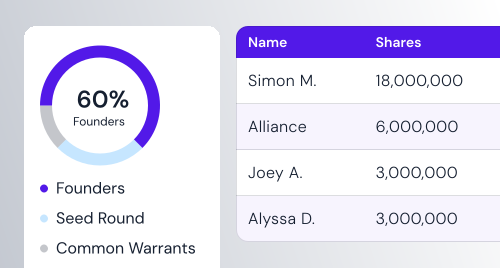
Round-modeling tool is a scenario modeling tool that helps the company management and the investors view the dilution of the cap table when there are new investments added to the company. Additionally, our round-modeling tool also takes into consideration a new option pool after the new investment is made.

To use the round modeling tool on Eqvista, navigate to the ‘Round Modeling’ tab under the ‘Modeling’ menu. You can customize different financial scenarios by entering values across four key fields: pre-money valuation, post-money option pool percentage, and investment amount. Additional options allow you to include or exclude:
- Preferred shares conversion rate (included by default)
- Convertible note interest (include to factor in earned interest)
- Convertible basis (pre-money or post-money, determining when notes convert relative to the new investment)
Key Features of Eqvista’s round modeling:
- Pie chart & key figures for new investments
- Basic and advanced versions for new investments
- Pre-money & post-money convertible basis
- Multiple inputs for date of investment, investment amount, and pre-money & post-money valuation
- Convertible note interest options
- Instant reactivity for input data
- Convertible rate options for preferred shares
- Downloadable financial modeling in PDF format
Round modeling is most useful for companies with complex cap tables or for those who want to consider different investment scenarios before committing. The tool helps manage the cap table, founder share dilution, and its impact on other existing shareholders.
Why Choose Eqvista Financial Modeling?
Eqvista is not only a leading player in cap table management, but also provides the best solutions for scaling your company. Here’s why over 25,000 companies trust Eqvista for their financial modeling needs:
- Trusted by founders + VCs across more than 25,000 companies
- Easily calculate share dilution effects and exit strategies.
- Make better decisions about when to sell your shares.
- Get a more accurate picture of your company’s value.
- Smart built-in algorithms that handle the complex mathematical aspects of financial models
- User-friendly interface with easy-to-read visuals, graphs, and PDF export for sharing with all stakeholders
Try out Eqvista today!
Finance teams and investment firms usually spend hours of valuable time to form cap tables and potential exit scenarios in spreadsheets. Building these models from scratch is time-consuming and difficult. And if you’re running a small startup, you might not even have someone with the expertise to model financing or exit scenarios. Eqvista has solved this with its financial modeling tools.
Eqvista built this financial scenario modeling software to help you understand the impact of your company’s future financing rounds or possible exits. Make use of Eqvista’s financial modeling features to easily see what is needed for your company and manage your equity effectively. Get started today at, reach out to the Eqvista team to learn more about waterfall analysis and round modeling.