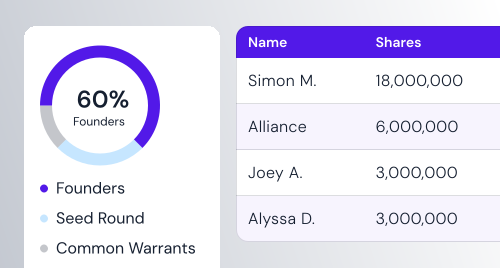
When a company reaches its Series B round, the cap table is no longer only a basic ownership list. It becomes more like a financial record, formed by multiple funding rounds, different types of investors, many SAFE conversions, and an expanding employee option pool.
According to PitchBook, the average Series B round in early 2026 is around $28M at a post-money valuation near $130M, with sector variation ranging from about $15M for more commoditized categories to $75M+ for high-growth AI companies. Investors negotiate a 10–20% stake in the round. Layer that on top of an existing seed round, a Series A, and an employee option pool, and it’s easy to see why ownership records that were effortless a year earlier.
This article discusses the key differences between Series A and Series B, common cap table challenges at this stage, what features a cap table platform should offer as a company grows, and what a practical migration process looks like.

What Changes Between Series A and Series B
The distinction between the cap tables of Series A and Series B isn’t really about scale alone; it’s about the number of distinct things that now depend on the cap table being accurate. A Series A company is usually tracking a handful of investors and a simple option pool. By Series B, the same spreadsheet or lightweight tool is often being asked to support board reporting, audit prep, and dilution modeling all at once.
| Series A | Series B | |
|---|---|---|
| Investor base | Few Investors | Multiple Investors |
| Option pool | Simple option pool | Growing, more formalised equity programs |
| Reporting | Limited reporting | Audit and board-level requirements |
| Ownership tracking | Basic | Feeds financial reporting and compliance |
| Spreadsheets | Still manageable | Increasingly risky |
Apart from those, Series B cap tables typically go through a couple of other pressure points as well. Pro-rata rights come into play, secondaries begin to happen more frequently, and equity refresh grants begin to become more formalized as the team scales up.
Industry data backs up why this stage is a common inflection point. Crunchbase’s decade-long look at Series B trends found that even among companies that make it to a Series A, the odds of advancing to Series B are close to a coin flip, and Series B deal counts have held in the 600-to-900-per-year range in most years outside the 2021–22 peak, even as total dollars invested at the stage have swung far more widely.
Common Cap Table Problems Series B Companies Face
Cap table troubles typically do not occur in one fell swoop for Series B companies. Rather, these difficulties grow and accumulate over time, as the number of investor groups grows, the amount of stock issuance rises, and the reporting challenge becomes increasingly difficult to ignore. When it comes time for an audit or a new round of investment, it is too late.

- More stakeholders, more conflicting needs. Founders, VCs, SAFE holders, employees, and advisors all need different ownership information, which makes manual tracking harder.
- More complex financing events. SAFE conversions, pro-rata rights, dilution analysis, and new equity rounds can make ownership changes hard to track accurately.
- Scaling equity compensation. As hiring grows, option grants, vesting schedules, exercises, and expirations create more ongoing updates.
- Higher reporting pressure. Board reporting, audit prep, and investor requests demand cleaner and more reliable data.
- Financial reporting risk. Once cap table data feeds into ASC 718 reporting, even small errors can affect broader finance workflows.
- Higher cost of mistakes. Ownership inaccuracies at series B are no longer minor administrative issues. During fundraising, audits, or M&A discussions, even small errors can be costly, slow due diligence, and create unnecessary risk for the company.
An updated cap table is therefore not just about record-keeping. It is an essential tool for operational control. This is why the next section turns to the characteristics a Series B company should expect from its cap table system.
The Cap Table Features Series B Companies Actually Need
At Series B, cap table software has to do more than store ownership records. It needs to keep the data current, support larger equity activity, and give finance teams a cleaner path to reporting and planning. That is why the most useful features are the ones that reduce manual work while helping the company stay ready for the next financing event or audit.
Maintaining Ownership Accuracy
With more investor classes, more SAFEs, and more secondary transactions, a company needs a live, exportable source of truth rather than a document someone updates when they remember to. That generally means the ability to generate clean ownership reports on demand, give different stakeholders appropriate visibility into their own holdings, track convertible instruments like SAFEs and notes through to conversion, and reflect secondary transfers as they happen rather than after the fact.
Eqvista supports this through cap table reporting, a shareholder portal, and SAFE and convertible note tracking, so ownership data stays current without manual cross-checking whenever changes occur.
Managing Employee Equity at scale
Employee equity at Series B stops being something that happens occasionally and becomes an ongoing administrative workload: new grants, vesting schedules, exercises, expirations, and electronic acceptance records all need to be tracked consistently across a growing headcount. Option pools tend to expand accordingly it’s common for Series B companies to refresh or enlarge their pool as part of the round to accommodate a year or more of hiring.
Systems built for this stage typically handle option administration, equity grant issuance and acceptance, and certificate generation as connected workflows rather than separate manual steps.
Preparing for Future Financing Exits
Series B companies need to predict outcomes ahead of time, not just track them afterward. This means checking how a new funding round could change ownership and dilution before signing a term sheet, and seeing how proceeds would be split among share classes and liquidation preferences if there is an exit.
Round modeling and waterfall analysis help answer these ‘what if’ questions with real numbers instead of relying on rough spreadsheet estimates. This becomes especially important at Series B, since there is more money and more people involved than in earlier stages.
Staying Audit-Ready
As equity compensation becomes a bigger part of the business, cap table data starts to play a direct role in formal accounting, especially for ASC 718 stock compensation reporting, which relies on accurate 409A fair market values. It’s also important to keep equity records, board consents, and supporting documents in one place, instead of spread out across emails and shared drives, because auditors and investors often ask for these documents with little warning.
Being able to import spreadsheets is helpful too, since most companies at this stage are pulling together old records from less organized systems rather than starting fresh.
Note on Valuation at Series B
In the Series B stage, valuation becomes relevant due to the increased number of share issuances and shareholder changes, as well as the development of finance and compliance processes. In such a way, the importance of 409A diminishes as an independent process and becomes one of the integral parts of cap table management and ASC 718 accounting.
- 409A obligations increase at Series B. Since option grants get larger, companies require a revised fair market value in order to keep the valuation record current and defensible.
- 409A feeds directly into ASC 718 calculations. Fair market value, determined through 409A valuations, is required for ASC 718 calculations. That connection makes the valuation process even more important as reporting requirements grow.
- Coordinating them separately adds risk. When valuation and cap table management run through different providers, there’s more room for the two records to fall out of sync, a discrepancy that tends to surface at the worst possible time, like mid-audit or mid-diligence.
Keeping 409A valuations current and well-documented as the company scales is one of the more direct ways to manage that risk before it becomes a diligence problem.
This is one reason some companies look for a platform, like Eqvista, that offers 409A valuation services alongside cap table management directly, reducing the coordination overhead between the two.
Why Series B Companies Are Switching Cap Table Platforms
Series B companies often reach a point where cap table management needs to stay accurate, responsive, and easy to scale. At this stage, the reasons for switching are usually practical: pricing becomes harder to justify, support needs become more urgent, feature requirements become more specific, and data access becomes more important.
- Pricing that scales awkwardly with growth. Some platforms charge in ways that become harder to justify as shareholder count and transaction volume increase which is exactly the direction a Series B company is headed.
- Support responsiveness during time-sensitive moments. Financing activity, option exercises, and reporting deadlines don’t leave much room for a slow support queue.
- Feature gaps or unnecessary complexity. Some companies find their existing tool doesn’t fully cover Series B-specific needs (like formal round modeling or waterfall analysis); others find they’re paying for enterprise-level complexity they don’t need yet.
- Data portability. As ownership records grow more complex, companies want confidence that their historical data remains fully accessible and exportable, not locked into a single vendor’s format.
Eqvista is one platform companies have moved to for these reasons, offering transparent pricing, direct support access, and full cap table, equity administration, and 409A coverage without enterprise-level overhead, but the underlying decision points above apply regardless of which platform a company ultimately chooses.
A Migration Scenario: Migrating from Carta
Let’s make this more concrete with a hypothetical example. Imagine a company called Meridian Labs. It has three co-founders, two main VC funds from its Series A and B rounds, twenty-five SAFE investors who converted at different valuation caps, and 65 employees with options on various vesting schedules. While this company isn’t real, its structure is typical. According to PitchBook and NVCA data, Series B companies often have several investor classes, an active option pool, and a shareholder base that’s much larger than just the founders by the time they start thinking about Series C.
Meridian Labs is preparing for a Series C conversation roughly 18 months after closing its Series B. Its cap table on Carta reflects three founders, two VC funds, twenty-five SAFE investors who converted at three different valuation caps during the seed and bridge stages, a small block of common shares issued to advisors over the years, follow-on investments from both existing VC funds participating again in the Series B, and 65 employees across four vesting schedules, some with early-exercise elections, a few with option grants issued right before a policy change to the company’s standard vesting terms.
The company’s finance lead has also just been asked by the board to produce a fully diluted ownership summary and an ASC 718 expense estimate ahead of the next audit, and has started to notice that Carta’s pricing has scaled up meaningfully as the shareholder count has grown a common pattern as companies move from Series A into Series B and beyond.
Step-by-step Migration Flow
The migration process is designed to be low-risk and manageable, even for companies actively engaged in financing activities.
Step 1: Data access
Meridian’s finance lead either grants the Eqvista team direct access to the Carta account or exports the relevant cap table reports and history. Either approach gives the receiving team what it needs to start mapping the data.
Step 2: Onboarding and Mapping
The Eqvista team reconstructs the historical transaction record: three rounds of financing, twenty-five SAFE conversions at their respective caps and discounts, the advisor common share grants, follow-on purchases from existing investors, and every option grant, exercise, and cancellation across the employee base.
Step 3: Data is checked for errors
Before anything goes live, the imported data is checked against the original Carta records line by line, flagging, for example, a handful of option grants with mismatched vesting start dates or a SAFE conversion that needs a second look.
Step 4: The company reviews and approves
Meridian’s finance lead and legal counsel review the reconstructed cap table, confirm it matches the source records, and approve it before the company starts using it as the system of record.
For a company with this level of complexity, the process typically runs 3–5 business days end to end, a timeline that holds up even with a two-digit number of SAFEs and a multi-year option grant history, because most of the work is systematic reconciliation rather than manual re-entry.
The point of walking through a scenario like this isn’t that switching tools is inherently valuable , it’s that a company heading into Series C diligence needs its historical ownership record to be complete and defensible, and a structured migration is one way to get there without disrupting an active fundraising timeline.
FAQs
Here are a few quick answers to common questions about Series B cap tables, migration, and why companies switch to Eqvista before the next round.
How often should a Series B company update its cap table?
The cap table should be updated every time an ownership event occurs. Beyond that, a full review should happen before any major milestone such as a new round, an audit, or an M&A discussion. A good rule of thumb is that the cap table should never be more than one transaction behind.
What is the difference between a fully diluted and a basic cap table view?
A basic cap table shows only shares that have been issued and are currently outstanding. A fully diluted view adds everything that could become equity in the future. Investors and acquirers almost always work from the fully diluted view because it shows the true ownership picture, including dilution that has not yet happened.
When should a Series B company get a 409A valuation?
A new 409A valuation is needed when a financing round closes, when a material event affects company value, or when 12 months have passed since the last valuation. At Series B, where option grants are issued more frequently to a growing team, updated 409A valuations are needed more regularly than at earlier stages.
What happens to SAFE notes when a Series B round closes?
If the qualifying conditions are met, SAFEs convert into preferred shares at the terms defined in the original agreement. The SAFE holders become shareholders, their instruments are removed from the cap table, and new preferred shares are added in their place, changing ownership percentages across the entire cap table.
Can a company run round modeling before term sheets are signed?
Yes, and most Series B companies should. Running scenarios before a term sheet is signed shows what different deal structures mean for ownership before any commitments are made. It helps founders understand which terms matter most to their ownership outcome and helps the board evaluate whether a proposed structure is in the company’s best interest before negotiating final terms.
Why a Clean Cap Table Matters
At Series B, a clean cap table is more than a compliance requirement; it is a strategic asset that helps the company maintain control as ownership becomes more complex. When the records are accurate and centralized, the team can focus on growth instead of untangling avoidable errors.
Companies with well-maintained cap tables are better positioned to move quickly in fundraising, M&A, and audits. That speed matters because every delay in ownership verification or reporting can slow down the next stage of growth.
Eqvista is built to help Series B companies manage that complexity with one organized system for ownership, reporting, and equity tracking. The goal is to make the cap table easier to maintain now, while setting the company up for the next round with less friction.
Whether you’re raising your next round, preparing for due diligence, or considering a move from spreadsheets or another cap table platform, Eqvista can help simplify the process. Our Customer Success team will guide you through every step of the migration, from onboarding your cap table to getting your company ready for what’s next.