In this edition of the Founder Spotlight series, we had a conversation with Alexandru Stanescu, Partner at Lexters Law Firm, to explore what it really takes for European founders to scale beyond their home markets and compete in the US. Alexandru brings extensive international experience across institutions such as the World Bank, the European Court of Justice, and now Lexters, which gives him a rare, multi-dimensional perspective on global entrepreneurship and cross-border legal strategy. In this interview, Alexandru shares his insights on some of today’s most pressing topics for founders and delves into the nuances of US market entry, venture capital fundraising, intellectual property protection, dispute resolution, and navigating the rapidly evolving landscape of blockchain and digital asset regulation.
Whether you are a founder eyeing your first US expansion or an investor seeking to understand the legal terrain, Alexandru’s perspectives offer a compelling and practical roadmap.

Given your extensive international experience across institutions like the World Bank, European Court of Justice, and now Lexters, you’ve observed European entrepreneurship from many angles. What do you see as the defining characteristics of European founders—particularly those from CEE—compared to their counterparts in other regions, and why are they increasingly compelled to build in the US?
European founders, and especially those from Central and Eastern Europe, tend to be unusually resilient, technically strong and capital-efficient. Many have learned to build with fewer resources and to operate across borders from day one because their home markets are smaller or fragmented. That produces disciplined teams, strong engineering cultures and a sharper focus on product substance.
What they sometimes underestimate is how much the US rewards speed, commercial ambition and narrative. In Europe, founders often spend more time perfecting the product, while the US market expects a company to scale distribution and partnerships much earlier. That is one reason many CEE founders feel compelled to build in the US: not because Europe lacks talent, but because the US offers deeper capital pools, faster access to enterprise customers and a culture more comfortable backing category-defining bets.
The real advantage for CEE founders is to keep their European discipline and technical depth while learning to communicate a bigger vision in the American market. At Lexters, which is recognized by Chambers & Partners as a Band 1 law firm in Romania, we advise CEE technology founders on exactly that transition, combining US- and EU-qualified lawyers to bridge both legal systems from day one.
Drawing from your work at the World Bank on doing business indicators and contract enforcement, how do those experiences shape the advice you give founders on US market entry?
My World Bank experience reinforced a simple point: market entry is not only about demand; it is about execution risk. Founders often focus on sales strategy and overlook whether their legal and operational architecture can support scale. Companies win not only because they have a good product, but because they reduce friction in how they contract, hire, protect assets and resolve disputes.
When I advise founders entering the US, I encourage them to think early about the practical infrastructure of growth: US entity formation and Delaware incorporation, customer and vendor contracts under US commercial law, intellectual property ownership and assignment, employment and contractor agreements compliant with US labor standards, data privacy compliance including US state privacy laws, and a dispute-resolution framework that matches the business. Legal work should be part of market-entry design, not a post-closing clean-up exercise.
The strongest founders entering the US are usually the ones who make the company easy to diligence, easy to contract with and easy to trust.
For European founders who have achieved product-market fit in their home markets and are now seeking to expand to the US, what step-by-step approach would you recommend?
First, make sure the product-market fit translates to the US and is not just a home-market success. Then choose the right entry structure, whether that means selling cross-border initially, setting up a US entity early, or expanding in stages.
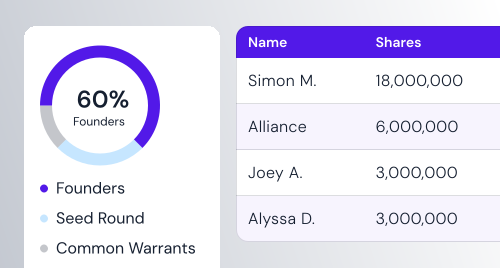
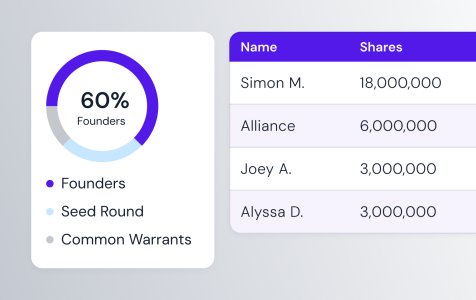
Just as important is putting the legal fundamentals in order: intellectual property registration and protection in the US, commercial contracts drafted under US law, cap table structuring for venture capital readiness, and corporate governance aligned with Delaware or other US state requirements, because those issues become critical once you start scaling or fundraising. The commercial strategy also needs adapting to US customer expectations, since pricing, sales cycles and go-to-market dynamics often differ significantly from Europe.
Above all, stay focused: it is usually far better to win one segment or market first than to expand too broadly too soon.
You’ve recently supported major technology projects, including Xiaomi’s expansion in Romania. How does Lexters differentiate itself when advising fast-scaling tech companies on cross-border growth?
What differentiates Lexters is that we are built around the realities of scaling technology companies rather than traditional legal silos. As a Chambers & Partners Band 1 ranked law firm in Romania with New York-qualified attorneys, we combine corporate and M&A, intellectual property, venture capital financing, fintech and blockchain advisory, data protection and GDPR compliance, and cross-border dispute resolution in a way that is especially relevant for technology businesses operating between Central and Eastern Europe, the United States and other markets.
For fast-scaling companies, that matters because the legal questions are never purely local. A technology rollout may involve market entry strategy, consumer law, data protection and GDPR compliance, MiCA and fintech regulation, branding and trademark protection, employment structuring and investment readiness simultaneously. The value is in integrating those workstreams so the client can move quickly without losing control of risk.
In projects like Xiaomi, the point is not only to solve a filing or contracting issue, but to help the client land smoothly in a new market, coordinate stakeholders efficiently and keep momentum.
With your practice in venture capital and private equity, what are the most common misconceptions European founders have about raising capital from US VCs, and how can they better position themselves?
A common misconception is that US investors are more aggressive versions of European investors. In reality, many US VCs assess opportunities through a different lens: speed of growth, market size, founder-market fit and the credibility of a category-defining story often matter as much as current traction.
Another misconception is that fundraising is mostly about the deck. Sophisticated investors carefully analyze team dynamics, governance discipline, IP ownership and whether the founder can recruit and sell in the US.
European founders can position themselves better by doing three things. First, present the company in US-scale terms, with a Delaware C-Corp or equivalent structure that US investors expect. Second, remove avoidable diligence friction by cleaning up cap table management, SAFE and convertible note documentation, IP assignments and regulatory compliance early. Third, show that you understand the US commercial environment, not just the product. Investors want evidence that you can sell, hire and operate inside the market’s legal and commercial expectations.
The founders who stand out are the ones who combine European substance with American-level clarity of ambition.

As someone admitted to the New York bar who frequently speaks on international arbitration, how does dispute resolution differ between Europe and the US in the startup context, and what should founders know upfront?
The main difference is that US disputes can become expensive and procedurally intense very quickly, particularly when drafting is loose or expectations were not aligned at the contracting stage. Many founders coming from European practice are not fully prepared for the pace, discovery burden and leverage dynamics that can arise in the US.
That is why founders should think about dispute resolution at the contracting stage, not after a problem appears. Governing law, venue, arbitration clauses, limitation of liability, IP ownership and termination mechanics all shape business risk materially. A single poorly drafted contract can cost a startup enormous time and negotiating leverage.
For cross-border startups, international commercial arbitration under institutions such as the ICC, LCIA or AAA is often attractive because it offers neutrality, confidentiality and enforceability under the New York Convention across jurisdictions. But the right mechanism depends on the counterparty, the type of claim and the jurisdictions involved. As a New York bar-admitted attorney advising through Lexters, I bring that cross-border dispute perspective to every engagement. The key lesson is simple: dispute strategy is part of business strategy.
Your experience at the European Court of Justice provides a unique perspective. How does that European legal background inform your US practice, particularly around data privacy and consumer protection?
A European legal background is especially valuable because Europe has often been earlier and more structured in areas such as consumer protection, platform regulation under the Digital Services Act and Digital Markets Act, data privacy under the GDPR, and emerging frameworks like the EU AI Act. That trains you to look carefully at fairness, transparency and how rules operate across borders.
In practice, that helps in two ways. First, it makes you more sensitive to issues founders may dismiss as secondary until they become serious: privacy, data transfers, dark-pattern risks and compliance by design. Second, it helps translate between legal cultures. Clients expanding in either direction need advisers who can see where legal instincts differ and where commercial assumptions will travel poorly.
For founders, the practical point is that privacy and consumer compliance are not separate paperwork tracks, but they are embedded in product design, user trust and enterprise readiness.
In your blockchain and digital assets practice, how does regulatory uncertainty in both US and European jurisdictions affect founders operating in this space, and how should they navigate it?
Regulatory uncertainty affects blockchain founders in two ways: it increases execution risk, and it increases the cost of being wrong. In both the US and Europe, founders need to think carefully about token design, licensing triggers, AML/KYC, custody, consumer-facing disclosures and the line between technology architecture and regulated activity.
Europe has moved toward a more structured framework through the Markets in Crypto-Assets Regulation (MiCA), which provides a comprehensive licensing and compliance regime for crypto-asset service providers, while the US has developed through SEC and CFTC enforcement actions, emerging legislation like the GENIUS Act for stablecoins, and sector-specific guidance. Founders cannot rely on broad assumptions such as “we are decentralized” or “we are only a software provider”. In this regard, the analysis has to be granular and jurisdiction-specific.
My advice is to build legal strategy into product strategy from the start. Map the activity, identify regulatory touchpoints, ring-fence the highest-risk functions and review the model each time the business changes. In digital assets, legal architecture is part of how the company survives.
How should European founders approach intellectual property protection when entering the US market, and what critical differences should they understand about exit opportunities in the US versus Europe?
On IP, founders should start with ownership and chain of title before thinking about filings. If the company cannot clearly show who created the code, brand assets or inventions, then patents or trademarks will not fix the deeper problem. Once ownership is clean, founders should decide what to protect through patents, trademarks, trade secrets or contractual controls.
In the US, founders should also be attentive to employment invention assignment agreements, contractor IP assignment clauses, US trademark registration with the USPTO, open-source license compliance and the practical relationship between IP diligence and fundraising or acquisition processes. At Lexters, our intellectual property practice is recognized by Legal 500 and IP Stars, and we guide technology companies through exactly this kind of cross-border IP structuring.
On exit, the US tends to offer a larger pool of strategic buyers, deeper capital markets and often a greater premium for companies with scalable commercial traction. Europe can produce strong exits, but many founders see the US as offering more pathways to outsized outcomes. The trade-off is that the US market expects stronger corporate governance, cleaner legal and financial documentation for due diligence, and faster scaling. Lexters advises on M&A transactions, venture capital exits and cross-border deal structuring to ensure that better exit optionality comes from better legal preparation long before any sale process begins.
Looking back on your own journey and the founders you’ve advised, what’s the one piece of counsel you’d give European founders considering building in the US that you wish you’d known earlier?
Do not wait to “feel ready” before learning how the US market really works. Many exceptional European founders delay too long because they want the product, team or traction story to be perfect. But the US rewards informed iteration more than perfect preparation.
Enter the market with humility, but not with smallness. Keep the discipline, technical rigor and efficiency that European founders have, but pair it with a willingness to sell earlier, ask for more and frame the business on a larger canvas. The founders who succeed are not the ones who abandon their European strengths, they are the ones who translate those strengths into a more ambitious operating model.
The earlier you understand that legal structure, commercial narrative and market presence all have to evolve together, the better your odds are. That is exactly the approach Lexters takes with every founder we advise—helping European technology companies build the legal, corporate and commercial foundations to succeed in the US market.