The importance of picking the right co-founders was brilliantly explained by Paul Graham. He says that co-founders are to a startup what location is for real estate. You can change anything about a house except its location. Similarly, a startup can change its core idea, mission, or targeted market, but changing its co-founders is hard.
Add to that the sheer improbability of two highly capable people being available, motivated, and compatible all at the same time, and the challenge becomes clear.
Hence, in this article, we will cover where to look for co-founders, how to evaluate them, and how to protect your equity structure once you find the right match.

Where Should You Be Looking for Co-Founders?
The following 4 avenues give you the best chance of finding the right co-founders.
Co-Founder Matchmaker Platforms
Dedicated platforms are the most direct route to finding co-founders who are actively looking to join other co-founders. Dedicated platforms are the most direct route to finding co-founders who are actively looking to join others. Create a clear profile highlighting your startup idea, skills needed, and location preferences to attract serious candidates.
Here we added a list of the best co-founder platforms:
| Platform | Key Features | Best for |
|---|---|---|
| Y Combinator Co-Founder Matching | AI-driven matches on skills/location; YC-backed expertise | Ambitious, accelerator-track founders |
| CoFoundersLab | Curated profiles; smart algorithms, built-in tools | Quality connections with developers/creators |
| Reddit r/cofounder | Direct posts/responses; unfiltered | Quick validation, casual outreach |
| StartuPage | Verified profiles; international teams (15+ countries) | Traction-focused technical co-founders |
| Founderio | Global entrepreneur network | International teams |
Social Media
LinkedIn is an underrated co-founder sourcing channel. Posting openly about what you are building and the profile of a co-founder you are seeking is highly likely to generate inbound leads.
To accelerate your search, you can proactively engage in communities where operators in your sector come together and have meaningful discussions. But first, you must build visibility as a credible founder. This involves taking simple steps like updating profile details and requesting recommendations from peers.
Networking Events
In-person events have a fundamentally different ROI from cold online outreach. A direct conversation at a conference allows both parties to assess energy, communication style, and commitment depth in real time. These things are notoriously difficult to convey or interpret via LinkedIn or email conversations.
As a founder, in 2026, you should consider attending Tech Week which is held in Boston, New York, San Francisco, and Los Angeles. Even cities like San Mateo, Charleston, and Charlotte host networking events aimed at startup founders and VCs.
Leveraging Professional Connections
Warm introductions remain one of the most reliable sourcing channels, even for co-founders. Your former colleagues already have first-hand evidence of what kind of people you work best with. This context about your work ethic and personality enables managers and mentors to make introductions to people who are operationally capable, trustworthy, and most importantly, compatible.
However, the worst thing you can do is reach out to every connection and ask for referrals from everyone. Instead, identify who among your contacts is likely to work or have worked with someone matching your needs. This will help you limit your referred leads to a manageable size.
Whom Should You Onboard as a Co-Founder?
Sourcing co-founder candidates is not even half the battle. Discerning whom to build is where the true challenge lies.
The Right Skill Set
A co-founder should cover the gaps you cannot. The most durable founding teams pair a technical builder with a commercially oriented operator. If you are the product and engineering wiz, prioritize candidates with go-to-market, sales, or finance depth. If you lead with distribution, find someone who can own the architecture. Redundancy in skill sets is a structural liability that tends to surface during the first real crisis.
Diverse and Mutually Exclusive Network
Beyond skills, look for someone whose relationships open doors that yours cannot. If you already have a deep enough network within the VC community, think of onboarding co-founders who can open up partnership opportunities for you down the road. If your network is filled with engineering talent, look for someone with a rich network of marketing talent.
The core idea is the same. You must find co-founders who can cover your gaps and vice versa.
Level of Commitment
Differences in commitment levels are one of the most common and most corrosive problems in early-stage founding teams. Before finalizing an equity split, have a direct conversation about time investment, salary expectations, and what each party is willing to sacrifice.
A co-founder who is still exploring the idea while you are all-in is not a co-founder. They might be an advisor at best, who may turn into a co-founder down the road, but not right now.
Character
You can always hire people to fill skill gaps. But there’s no simple fix for character flaws. Specifically, look for candidates who have:
- The ability to subordinate their personal ego to team outcomes
- The humility to acknowledge mistakes and reverse course quickly
- The resilience under the sustained pressure that all early-stage companies impose
- The ingenuity to find creative solutions when resources and time are constrained
Whether your founders have these qualities will determine how well you navigate inflection points.
Eqvista- Your Equity Partner Since Day One!
Finding the right co-founder is the first critical decision in a startup’s lifecycle. Formalizing that partnership correctly is the second. Many founding teams defer equity structuring until they are about to raise, which creates ambiguity and negotiating friction at the worst possible time.
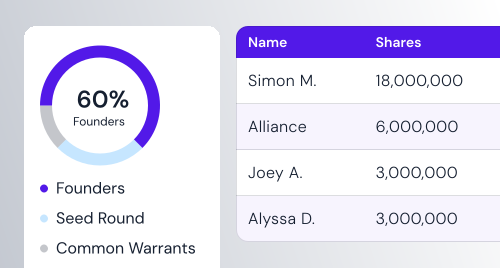
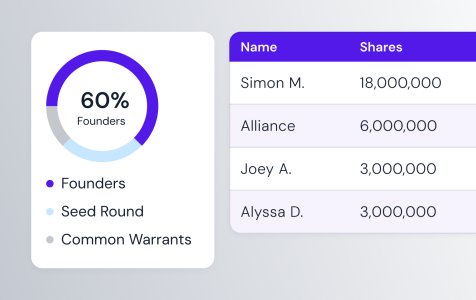
The moment you bring on a co-founder, your cap table begins.
Eqvista gives founding teams the tools to issue shares, maintain accurate ownership records, and present a clean, investor-ready equity structure from day one.
When investor due diligence begins, a well-maintained cap table signals operational maturity. Eqvista’s round modeling feature also allows you to stress-test different dilution scenarios before you accept a term sheet, so you negotiate from a position of clarity rather than guesswork.
Whether you are issuing founder shares, setting up an ESOP, or preparing for your first institutional round, Eqvista ensures that your equity structure supports your growth at every stage.
Contact us to get started!