Family offices today are far more than custodians of inherited wealth. They are active investors, business operators, and governance bodies who manage ownership stakes in family-run companies, private equity funds, real estate, and venture capital funds.
According to Deloitte, the number of family offices is expected to increase from 8,030 in 2024 to 10,720 by 2030, and their collective assets are projected to surpass $5.4 trillion by 2030. At the core of most family office portfolios sits the family-owned business. But no business can remain 100% family-owned indefinitely.
To attract senior talent and outside capital, founders inevitably dilute ownership by issuing stock options to key employees, warrants to early investors, and equity to late-stage investors. Multiply this across 3, 5, or 10 portfolio companies, and equity management quickly becomes one of the most complex challenges a family office faces.
Each company may carry its own cap table, vesting schedule, equity compensation logic, and 409A valuation history. Without a single, streamlined solution to track all of it, mistakes compound. Equity is over-issued, tax exposure goes unplanned, and family control quietly erodes.
In this article, we outline 7 strategies family offices can adopt to bring structure, discipline, and foresight to equity management across their portfolio.

Equity Management Strategies for Family Offices
Managing equity across a multi-company portfolio demands more than spreadsheets. It requires deliberate policies built to scale alongside your portfolio.

Standardize Equity Compensation
Businesses often tinker with equity compensation to better meet staff needs. If you are managing a single business, 3-4 forms of equity compensation are not that hard to track. But a family office is expected to track equity across multiple businesses. If your office oversees 10 companies at three forms of equity compensation each, you are responsible for 30 distinct securities before even accounting for investor-held instruments.
This leaves the door wide open for equity mistakes such as over-rewarding or under-rewarding employees, poor tax planning, and ultimately losing control of family-owned businesses. Hence, it is a good idea to standardize equity compensation across portfolio companies.
Establish a Regular 409A Valuation Cadence
Family offices tasked with the management of privately-held companies must establish a monthly or at least quarterly 409A valuation cadence. This goes beyond compliance. You absolutely need a 409A valuation to establish the fair market value (FMV) and the resulting taxable income of employees.
However, 409A valuations also serve as an unbiased and objective assessment of the portfolio company’s present value. These valuations can, hence, be communicated to family members so they remain apprised of the value of their assets.
If your reporting needs far exceed the functionality of monthly valuation updates, consider signing up for Eqvista’s Real-Time Company Valuation®, an AI-enabled solution built under the supervision of seasoned valuation analysts.
Align Equity Compensation with Family Interests
When designing equity compensation plans, family offices must balance two competing goals: maintaining control and attracting talent in a cash-efficient manner. This can be achieved through phantom stocks and stock appreciation rights (SARs).
Phantom stocks mirror the benefits of actual shares. They carry a price and pay dividends but do not confer voting rights. SARs extend the opportunity to benefit from share price appreciation without transferring ownership.
| Instrument | Voting rights | Dividends | Ownership transfer | Purpose |
|---|---|---|---|---|
| Actual shares | Yes | Yes | Yes | Full ownership |
| Phantom stock | No | Yes | No | Cash-like, align incentives |
| SARs | No | No | No | Share price upside |
Both instruments reward employees meaningfully without threatening family control.
Monitor Family Control Thresholds
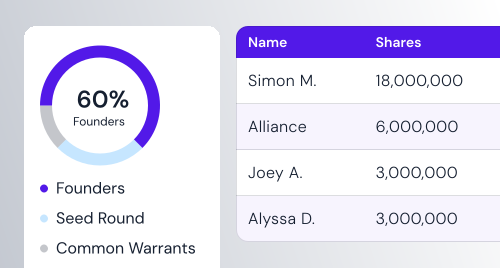
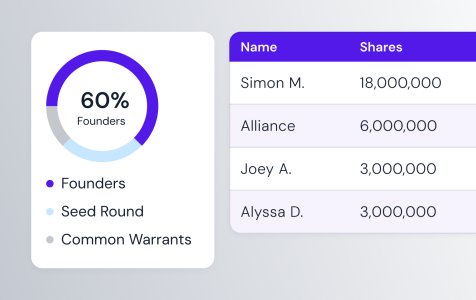
Monitoring family control is not as simple as setting an alert for when ownership drops below 50%. Modern companies have multi-class equity structures and issue convertible securities that can shift the ownership structure at any moment.
Family offices must therefore maintain dashboards displaying post-conversion ownership percentages in real time. The setup takes effort, but the investment pays off, particularly when portfolio companies are onboarding new investors or when a family member needs liquidity.
Negotiate Investor Rights Proactively
Poorly negotiated shareholder terms can have disastrous ramifications a long way down the road. Particularly, you need to keep an eye on how clauses related to rights of first refusal (ROFR), tag-along rights, and drag-along rights are framed.
ROFR prevents control from shifting to external parties through unanticipated third-party sales. Overly generous tag-along rights can limit the family’s ability to liquidate its holdings if a buyer is unwilling to acquire minority stakes. Drag-along rights ensure minority shareholders cannot block a sale.
You may benefit from modifying certain investor rights through sunset clauses, meaning that the rights expire after a certain amount of time or when the investor falls below a certain threshold.
Separate Family Liquidity Needs from Business Equity Needs
A portfolio company’s IPO timeline should not be driven by a family member’s personal need for liquidity. At the same time, it is also true that resentment can grow when members hold illiquid assets with no obvious exit in sight.
Liquidity planning is not an abstract concern, given the fact that wealth transfers worth an estimated $124 trillion are expected to occur in the US by 2048.
Hence, family offices need to formalize dividend policies to ensure a stable income for the family members. Another related strategy would be setting aside the dividends so that they can be used to buy back shares from family members who request exits. This allows family offices to arrange large exits for a select few family members if the liquidity needs of other members are not acute.
Plan for Succession Before it Becomes Urgent
Relationships with employees and key business partners are deeply impacted by how the family handles leadership transitions, ultimately impacting the company’s valuations.
One in three family offices expect to transition control within the next five years, yet succession planning remains one of the most neglected areas of family office governance.
From early in their careers, identify which family members are interested in operational leadership and which prefer to remain silent partners. This gives the office time to groom candidates, assign mentors, and prepare contingency plans well before transitions become urgent.
In parallel, trusts must be structured to ensure tax-efficient transfers of wealth to heirs. Depending on the type of trust, you will need to automate interest payments, schedule asset transfer dates, and prepare documentation that survives IRS scrutiny.
Eqvista- Your Cap Table Command Center for Family Offices!
Equity management across a multi-company family office portfolio is not a problem that resolves itself with good intentions. It requires real-time visibility, consistent policies, and the right infrastructure to hold everything together.
Eqvista’s cap table management platform gives family offices a single source of truth for equity across all portfolio companies. Enable you to track grants, model dilution, request and approve 409A valuations, and monitor ownership thresholds in one place.
If your family office is ready to bring order to its equity, schedule a demo with Eqvista today!