Consumer startups face a uniquely crowded and fast-moving funding landscape. Unlike B2B companies, consumer-focused founders must simultaneously prove product-market fit, build brand loyalty, and demonstrate scalable unit economics all before many institutional investors will write a check.
Understanding the right funding strategy for each stage is what separates startups that gain momentum from those that stall before launch.

What Is Early-Stage Funding?
Early-stage financing refers to financing obtained by a start-up in the first few stages of its life, from idea validation through growth. This includes pre-seed financing, seed financing, and sometimes a Series A round. In consumer startups, this stage becomes very important because it provides for the development of the fundamental elements – product development, customer acquisition, branding, and market testing.
At this stage, the founder does not have much profit. Essentially, the investor is making a bet on the entrepreneur’s idea, the magnitude of the opportunity, and the early signs of consumer interest. The more knowledgeable a founder becomes about each type of financing, the better they will be able to negotiate with investors.
The Consumer Startup Funding Landscape in 2026
However, the venture market in general has matured significantly since its peak during 2021-2022. Global investment levels reached a peak of $681 billion in 2021 before dropping significantly to $314 billion in 2024. Then, in 2025, the lowest level of early-stage investment was recorded at $24 billion in the first quarter, indicating the strict nature of investors in these rounds of financing.
Therefore, for consumer startups, this means one thing: investors need evidence to finance them. Gone are the days when pitches alone could attract funding. Seed investors now require some form of traction, including early users, waiting lists, cohort retention, and even pre-orders, before considering investing.
Core Funding Options for Consumer Startups
The first thing is to understand your options. Different sources of funding have varying criteria and considerations.
- Bootstrapping: Investing personal savings or profits earned from initial sales into one’s own business. This approach maximizes equity retention while imposing financial discipline; however, it restricts growth. Most appropriate for entrepreneurs trying out an idea before securing external funding.
- Friends/Family: An informal source of early-stage financing that is often the earliest money received. This flexible, rapid option carries risks that could damage personal relationships in case of failure. Financing amounts are usually between a few thousand dollars and $50,000.
- Angel Investors: Wealthy individuals investing $25,000 to $1 million into the business in return for equity stakes. Angel investors are especially useful to consumer startups due to their inclination to fund ideas based on passion and conviction, rather than financial models alone.
- Crowdfunding: Consumer startups can use equity crowdfunding platforms to raise $5 million per year, according to SEC regulations. Reward-based crowdfunding, which is ideal for consumer goods, provides capital while simultaneously validating demand and serving as early customers.
- Accelerators/Incubators: Y Combinator is an example of programs offering up to $250,000 in funding coupled with mentorship and networking opportunities. The “Demo Day” model of such programs ensures invaluable visibility among investors, which is difficult to achieve otherwise.
- Venture Capital (Seed/Series A): This is institutional capital provided by VC firms beginning at $500,000 for seed and growing to $2-$15 million for Series A. VCs will expect high growth and may ask for board positions. You need to involve VCs only after getting repeatable traction.
- Grants: Non-dilutive grants can be sourced from both government and private organizations (SBIR, SBA grants), depending on whether your business falls into innovation and/or underrepresented founder categories. These types of grants do not require any dilution but are highly competitive.

Matching Funding Strategy to Each Stage of the Company
Funding strategies cannot be one-size-fits-all. What works well depends entirely on your company’s stage. Creating an organized plan ahead of time can make all the difference.
Pre-Seed (Idea → MVP)
In the pre-seed stage, securing external investment will be challenging until there is a working product. At this stage, bootstrapping, friends/family investments, and angel investors in very early-stage startups are the main sources of funding. The aim here is to develop an MVP and receive initial user feedback. At this stage, raising $10,000-$150,000 is achievable.
Seed (MVP → Product-Market Fit)
The seed stage marks the beginning of serious fundraising efforts by consumer startups. Seed rounds involve pitching angel syndicates, early-stage venture capitalists, and accelerators. Pitching an idea backed by some data, such as cohort retention rate, user growth rate, or revenue, makes a seed pitch far more convincing. Usually, seed rounds raise $500,000-$3 million.
Series A (Growth → Scale)
Series A rounds are meant for consumer startups that have proved their ability to achieve product-market fit and build a growth engine. At this point, institutional VCs expect revenue growth, good LTV/CAC ratios, and a solid plan for scaling customer acquisition. Series A rounds usually raise between $2 million and $15 million.

What Investors Look for in Consumer Startups
Startups in the consumer space receive higher scrutiny than enterprise businesses at an early stage because consumer behavior is less predictable. The five critical signs that investors look for in 2026 include:
- Retention over acquisition – Investors are interested in ensuring that there is a return visit by users. Day-30 retention is an indicator of product-market fit, rather than novelty.
- Unit economics – The customer acquisition cost (CAC) and lifetime value (LTV) should indicate a path towards profitability. A common benchmark for success is a 3:1 ratio between LTV and CAC.
- Capital efficiency – Founders who can grow the business while keeping costs down are favored for their term sheets.
- Founder-market fit – In terms of consumer products, it is usually safe to assume that investors rely heavily on whether founders have a strong understanding of their consumers.
- Size of the market – Venture-backed startups require large markets to generate attractive returns. The minimum TAM for venture capital interest should be $1 billion.

Common Mistakes to Avoid during Early Stage Funding
Even talented founders stumble on avoidable fundraising errors. These are the most costly ones:
- Raising too much money too soon – Overvaluing the company makes subsequent funding difficult when the business is unable to meet the inflated expectations.
- Pitching to the wrong investors – VCs with expertise in B2B software-as-a-service (SaaS) won’t be interested in investing in consumer products. It’s best to understand what a venture capital firm’s portfolio looks like before approaching them. The Eqvista guide on how to find an investor for your startup explains precisely what that entails.
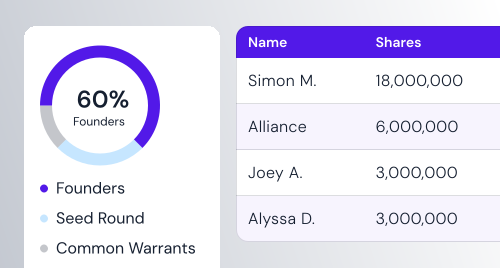
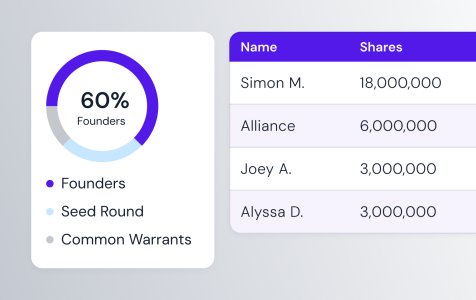
- Neglecting the cap table – Each percentage of equity you grant early on adds up. Offering a high equity stake from the get-go in a pre-seed will result in a very small ownership stake during the Series B.
- Not having a financial model – A bottom-up financial model is expected even at the seed stage of funding. Not bringing one along shows a lack of preparation.
- Not getting a valuation done – An independent valuation of your business improves your negotiation position, shows financial maturity, and builds trust with institutional investors.
How Eqvista Helps Consumer Startups Raise with Confidence
Getting early financing begins with valuing yourself and then effectively selling yourself to potential investors. Eqvista offers professional 409A valuations and startup business valuations that provide consumer entrepreneurs with the financial backing that is needed to negotiate their terms.
In addition to valuation services, Eqvista’s equity management software helps entrepreneurs create shares and manage cap tables throughout the various stages of financing. From raising your initial angel financing all the way to Series A and beyond, Eqvista is there to help you every step of the way.