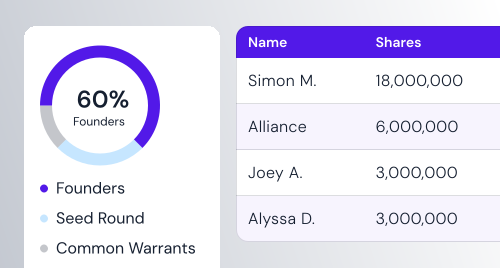
Dividend recapitalizations involve issuing new debt to pay out a special dividend to investors. If you compare the before and after snapshots of the capital structure, you will notice that some of the equity is replaced with debt after a dividend recapitalization.
Companies pursue dividend recapitalizations as an alternative exit facility that doesn’t drain its own cash reserves or require acceleration of listing plans. Another unexpected benefit of dividend recapitalization is that it increases the leverage for investors who remain. On the flip side, the company must deal with a greater debt burden.
In this article, we will provide a structured framework for approaching the various payoffs and complexities associated with dividend recaps.

Dividend Recapitalizations vs. Normal Dividends
The following table summarizes how dividend recapitalizations differ from normal dividends:
| Aspect | Dividend recapitalizations | Normal dividends |
|---|---|---|
| Frequency | Special kind of dividend very few companies offer, not more than once in their lifecycle | Typical, periodic income redistribution expected from stable stage companies |
| Funding source | Funded by new debt | Funded by cash reserves and profits |
| Impact on leverage | Increases leverage for remaining investors | Doesn’t impact leverage |
| Cash flow impact | Creates recurring cash outflow in the form of debt repayments | One-time cash outflow |
| Primary purpose | Provide liquidity or partial exit to investors | Generate income for investors |
Executing a Dividend Recap: A Three-Stage Framework
Let’s think of the dividend recap process as a three-step process involving planning, execution, and ongoing compliance.

Model the transaction rigorously
Before approaching lenders, your deal team and fund CFO must establish how much debt the portfolio company can absorb without risking derailing its operations. Start by comparing your company’s debt-to-income (DTI) with industry peers and other companies of similar size. Then, build financial models to assess operational health across different DTI scenarios.
Best practices for dividend recap modelling:
- Before committing to dividend recaps, test how different leverages and timings impact the internal rate of return (IRR) and distributions to paid-in capital (DPI) at the fund level to check if dividend recaps are worth pursuing.
- Ensure that your financial model incorporates expected debt covenant thresholds such as maximum leverage ratios and minimum coverage ratios.
- Obtain a third-party solvency opinion to confirm that the company’s assets exceed its liabilities post-transaction and the company can keep up with debt repayments as well as covenant thresholds. This adds a layer of legal protection against fraudulent conveyance claims.
Secure financing and distribute proceeds
If your financial modelling confirms dividend recap viability, you can approach lenders to finalize the debt financing structure. Typically, for dividend recaps, lenders may extend leveraged loans (a type of high-interest loan extended to high-risk entities) or subordinated debt (high-interest, low-priority, unsecured loans).
Once the loan is sanctioned, your financing team must then manage the distribution to LPs in accordance with the fund’s LPA.
Best practices for dividend recap distributions:
- Verify hurdle rates, carried interest, catch-up provisions, and any other terms related to distributions before building waterfall analysis models.
- Consider automating waterfall analysis via Eqvista to preview exactly how the prospective dividend would split between limited partners (LPs) and general partners (GPs), and verify alignment with your limited partnership agreement (LPA).
- Communicate proactively with LPs so they understand that the distribution is debt-funded, not earned from operations, and how it affects the residual value of their stake (RVPI).
Managing ongoing compliance and oversight
After distributing the proceeds from the dividend recap, the finance team’s responsibilities intensify. The portfolio company must now satisfy lender-imposed covenants, such as maximum net debt-to-EBITDA ratios and fixed-charge coverage requirements, until the new debt is repaid. Breaching these triggers can allow lenders to exert greater influence over operations or demand accelerated repayments.
Best practices for post-distribution compliance:
- Establish a real-time monitoring framework for covenant compliance. Track performance metrics against covenant thresholds on a monthly basis instead of quarterly.
- Use integrated fund administration software as a single source of truth, so your team can assess the fund’s financial position, including the portfolio companies’ debt service obligations, without reconciling across multiple spreadsheets.
Post-dividend recap realities: What greater debt actually means
A dividend recap is not a cost-free liquidity event. The debt added to the portfolio company’s balance sheet comes with lasting consequences that fund managers must weigh honestly:
- Reduced strategic flexibility: With more cash flow committed to debt service, the company has less room to invest in growth initiatives, navigate a downturn, or pursue opportunistic M&As.
- Refinancing exposure: If the debt matures before the fund fully exits, the portfolio company may need to refinance in a less favorable interest rate environment, compressing returns.
- Elevated default risk: Highly leveraged companies are more vulnerable to revenue volatility. Even modest underperformance relative to covenants can escalate into a technical default.
- LP relationship risk: If LPs interpret the distribution as a sign of financial engineering over value creation, it can affect future fundraising dynamics.
When should you consider dividend recaps?
A dividend recap is typically defensible when the following conditions align:
- The portfolio company has strong, stable EBITDA with consistent cash flows and meaningful headroom above likely covenant thresholds.
- There is a genuine need for LP liquidity, such as when the fund is approaching the end of its life but an exit is not yet optimal.
- Interest rates are manageable relative to the portfolio company’s debt service capacity.
- The company’s capital structure is clean, and the solvency test can be passed comfortably, not just narrowly.
Conversely, pursuing a dividend recap when EBITDA is under pressure, covenant headroom is thin, or interest rates are elevated significantly increases the probability of financial distress.
Eqvista- Precision Equity Management for High-Stakes Transactions!
Dividend recapitalizations can unlock real value but only when executed with precision at every stage. From pre-transaction waterfall modeling to post-close covenant tracking and LP reporting, the operational demands are significant. A single miscalculation in distribution allocations or a missed covenant trigger can erode the very returns the recap was designed to protect.
Eqvista’s equity management platform gives fund managers the clarity they need to navigate these moments confidently. With automated waterfall calculations, real-time portfolio visibility, and a dedicated data room for transparent reporting, Eqvista ensures that every stakeholder works from the same accurate picture.
Planning a dividend recap? Contact Eqvista to see how our platform supports seamless execution!