How to Acquire a Startup: Timing, Planning, and Key Strategies
This article covers everything you need to know about acquiring a startup successfully.
Acquiring a startup can accelerate your roadmap, add talent, and expand your customer base faster than building internally. But a poorly timed or structured deal can drain cash, distract your team, and destroy the value. According to CB Insights, global venture deal activity fell 19% year over year to 27,000 deals in 2024, while VC-backed companies that went public in 2024 waited a median of 7.5 years from first funding to IPO.
This article explains when buying a startup makes sense, how to plan the deal, what to review in due diligence, how to structure the transaction, how to value the target, and how to measure success after closing.
When Buying a Startup Makes Sense
How to acquire a startup starts with buying for a clear strategic reason, not just because a target is available. The most successful early-stage acquisitions solve one specific business problem better and faster than an internal build could.
A startup acquisition makes sense when the target solves one specific business problem better than an internal build can. For most early-stage founders, that means buying a product feature, an engineering team, a customer base, or a capability that shortens the time to revenue.
According to McKinsey’s 2026 M&A trends report, dealmaking remains essential when companies need to adapt to rapid change, pursue new sources of growth, and strengthen competitiveness.
The best reasons to buy
- Buy when the target helps you launch faster.
- Buy when the team has expertise you cannot hire quickly.
- Buy when the customer base gives you a clear distribution advantage.
- Buy when the technology would take too long to build internally.
- Buy when the target fits your product roadmap, not when it distracts from it.
Build vs. buy
Use this framework before approaching any target:
| Situation | Build | Buy |
|---|---|---|
| Core to your competitive moat | yes | No |
| Available talent in the market | yes | No |
| Market window is tight | No | Yes |
| Technology would take 12+ months | No | No |
| Customer base already exists | No | Yes |
| Capability is non-core but needed | No | Yes |
How to Time a Startup Acquisition Well
The proper buying point would typically occur only after you and your own business have sufficient stability to incorporate another organization into it.
According to CB Insights, early-stage transactions were relatively stable in 2024 despite a decline in venture dealmaking, and 74% of artificial intelligence transactions were early-stage. This implies that entrepreneurs still have the chance to purchase young firms, although they should be careful since funds are not flowing everywhere.
Good timing signals
- Your core product is stable enough to handle integration work.
- You have board or investor alignment before outreach starts.
- The target has reached a product milestone but still lacks scale.
- The seller needs liquidity or a strategic home more than a stand-alone raise.
- Your team can run the deal without weakening core execution.
Bad timing signals
- Your company is still searching for product-market fit.
- Your cash runway is too short to support closing and post-close costs.
- Your legal and finance records are not clean enough for your own diligence process.
- You are buying because a competitor showed interest, not because the target fits.
How to Build a Clear Acquisition Plan
Before reaching out to your target, make sure to write a page-long acquisition plan in which you specify why you want to do this, what you are acquiring, what budget you have for this, and what you expect from this process at the end.
As noted by Thomson Reuters’ 2024 legal due diligence guide, material risk areas such as contracts, liabilities, compliance issues, and intellectual property must be taken into consideration by buyers during their due diligence process.
What your plan should include
- A one-sentence acquisition thesis.
- The exact capability, market, or customer value you want.
- Your maximum budget and preferred payment structure.
- The team members responsible for finance, legal, product, and integration.
- A 30-day and 90-day post-close plan.
What to Review Before You Buy
Due diligence is the process of confirming that the startup you think you are buying is the one that actually exists.
Thomson Reuters says due diligence should identify likely risk areas, define tasks clearly, and assemble the right experts for areas such as taxes, real estate, and IP. For early-stage startup deals, the most important reviews are usually legal ownership, contracts, cap table accuracy, and technical transferability.
Due diligence should identify likely risk areas, define tasks clearly, and assemble the right experts for areas such as taxes, real estate and IP. For early-stage startup deals, the most important reviews are usually legal ownership, contracts, cap table accuracy and technical transferability.
Core diligence checklist
- Certificate of incorporation and formation records.
- Cap table and stock issuance history.
- Board approvals and investor rights documents.
- Founder, employee, and contractor agreements.
- IP assignment documents.
- Customer and vendor contracts.
- Security policies and incident history.
- Tax filings and outstanding liabilities.
Startup-specific red flags
- Missing invention assignment agreements.
- Contractors who wrote code without signed IP transfer terms.
- Revenue claims that do not match signed contracts.
- A cap table with undocumented promises or side letters.
- One customer represents too much of total revenue.
Choosing the Right Deal Structure
An acquisition of an early-stage startup can take any of three forms: an asset deal, a stock deal, or a merger. In an asset deal, you get to choose from the assets, which could be the code, the contract, or the IP. On the other hand, with a stock deal, you will acquire the entire entity with its legacy, responsibilities, and liabilities.
Common structures founders use
- An Asset purchase is useful when you want technology, IP, or selected contracts.
- Stock purchase is useful when the cap table is clean and liabilities are manageable.
- A Merger is useful when you want full integration into your company.
Common consideration structures
- Cash plus earnout is useful when performance is still early and uncertain.
- Cash plus stock is useful when you want seller alignment after closing.
Terms that matter most
- Representations and warranties.
- Indemnification scope.
- Escrow amount and timing.
- Founder retention terms.
- Vesting treatment for any rolled equity.
What Happens After the Deal Closes
The transaction is not complete just by signing the paperwork. McKinsey’s 2026 analysis shows that buyers need a clearer deal rationale and faster decision-making in uncertain markets, which makes post-close execution critical. For founders, the real test is how quickly the acquired product, team, or customer base starts creating value for the core business.
First 30 days
- Announce the deal clearly to employees and key customers.
- Lock in access to systems, code repositories, and contracts.
- Clarify reporting lines for the acquired team.
- Preserve customer support continuity.
- Confirm that promised retention packages are documented.
First 90 days
- Measure product integration milestones.
- Track customer retention from the acquired base.
- Review whether the original acquisition thesis is being met.
- Remove duplicated tools and costs where possible.
- Watch founder and employee retention closely.
How to Measure Acquisition Success
An effective acquisition should make a positive impact on at least one critical operating metric during the first two quarters. It all depends on the reason for the acquisition of the startup to know what metrics are appropriate. But generally, they include such factors as additional revenue generated, time saved on engineering efforts, talent retention, and churn rate post-acquisition.
In a more discerning market environment, these are what truly matter in an acquisition, not just its headline value.
| Metric | Why it matters | What good looks like |
|---|---|---|
| Time saved on roadmap | Shows build-vs-buy payoff | Product launch moved forward by months |
| Customer retention | Tests whether the acquired users stay | Most key accounts remain active after close |
| Team retention | Protects talent value | Founders or key engineers stay through transition |
| Integration cost | Keeps the deal realistic | Costs stay near the approved budget |
| Revenue contribution | Proves commercial value | Acquired product or accounts add measurable revenue |
A good acquisition should improve at least one important operating metric within the first two quarters. The chart below helps compare the factors that matter most when judging whether the deal is actually working. Use it to keep the focus on strategic fit, team quality, and integration effort.

If the strongest factors score well, the acquisition has a better chance of creating real value after close. If the chart shows weak alignment, the deal needs a closer review before moving forward.
Startup Acquisition FAQs
The questions below cover the points founders most often ask before moving forward with a startup acquisition. Each answer is designed to give a direct, practical response that can help you evaluate timing, diligence, valuation, and deal structure more clearly.
When is the best time for a startup to acquire another startup?
The best time is when the buyer has a clear strategic reason, enough runway to close and integrate the deal, and internal stability to handle the extra work. A weak market can create opportunities, but only prepared buyers benefit from them.
How should an early-stage founder value a startup acquisition?
The best approach is to combine strategic fit, replacement cost, customer value, and downside risk. For very early-stage targets, current revenue may matter less than the team, the technology, or the speed advantage the acquisition creates.
What is the biggest risk in acquiring a startup?
The biggest risk is integration failure. A deal can look attractive on paper, but if key employees leave, customers churn, or the code is hard to absorb, the strategic value falls quickly.
What documents matter most in startup acquisition due diligence?
The most important documents are the cap table, stock issuance history, IP assignments, employee and contractor agreements, customer contracts, and tax records. These documents show whether the buyer is getting clear ownership, clean obligations, and real commercial value.
Should a startup acquisition be paid in cash or stock?
The strongest structure often uses both. Cash helps complete the transaction, while stock can align the seller with future performance and reduce immediate pressure on the buyer’s runway.
How long does a startup acquisition typically take?
A startup acquisition typically takes about 3 to 9 months from first serious discussions to closing, depending on diligence, negotiation, and regulatory complexity. Once the deal is active, the final signing and closing stage can move faster, but the full process usually takes months rather than weeks.
What happens to startup employees after an acquisition?
Startup employees often face role changes, retention packages, or integration into the buyer’s organization, but outcomes vary by deal. According to U.S. Census-based research, acquired employees are more likely to leave than comparable hires, and startup acquisitions can also trigger new employee entrepreneurship after the deal.
How Eqvista Helps Founders Stay Deal-Ready
A startup acquisition is easier to execute when the equity structure is clear, the cap table is accurate, and ownership records are easy to review. Eqvista helps founders maintain that level of clarity, which supports faster diligence, cleaner decision-making, and fewer delays during a transaction. For companies planning growth, fundraising, or a future exit, strong equity management is not just an admin task; it is part of being acquisition-ready.
A clean cap table managed through Eqvista also makes you a more credible buyer. When your own equity records are accurate and auditable, counterparties gain confidence faster, legal review moves more quickly, and deal timelines compress.
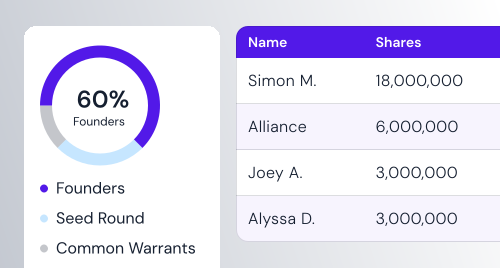
Start Managing Your Equity with Eqvista
Build your cap table, manage equity, and keep ownership organized as your company grows.