Hundreds of OpenAI employees recently cashed out their equity holdings through a company-run tender offer, with many becoming millionaires overnight. The headlines were astonishing. But behind the spectacle is a structural shift that every founder, HR leader, and startup employee needs to understand.
When I saw the headlines, I wasn’t surprised it happened. What struck me instead was recognition: this is exactly the product the market has been asking for. Yes, OpenAI executed an impressive transaction. But the process still seems very traditional: bring in a group of bankers and lawyers, prepare piles of documents and disclosures, agree on a valuation, put it into a PDF, and then announce the price to employees.
But here’s the thing that most of those headlines miss: the way OpenAI did it, while commendable, still reveals a massive gap in how private companies handle employee equity.
This is the gap I believe our industry must close.
Breaking Down The Old Model
For decades, the deal was simple: join a startup, accept a below-market salary, receive stock options, and wait (sometimes ten or fifteen years) for an IPO or acquisition. Your equity was a lottery ticket with no expiration date you could see and no way to cash it in early.
That model is no longer viable. Companies are staying private longer than ever. The median time to IPO has extended well beyond a decade. Employees are watching their most productive years pass while their equity stays speculative wealth locked in a spreadsheet.
Tender offers can become part of how companies attract and retain talent. Employees should not always have to wait ten or fifteen years for an IPO or acquisition before seeing any benefit from the equity they helped create.
Pre-IPO Liquidity: Not Just for Unicorns
OpenAI is an outlier because of the numbers, but not because of the idea.
This is the point most commentary misses. The mechanisms powering pre-IPO liquidity- company-sponsored tender offers, structured secondary sales, special purpose vehicles (SPVs), and curated secondary marketplaces- are not exclusive to companies valued at hundreds of billions of dollars. This should not be limited to companies valued at hundreds of billions of dollars. A company worth $200 million, or even $10 million, can start thinking about structured liquidity.
The transaction does not need to produce $30 million for each employee. For many people, $300,000, $500,000, or $1 million can completely change their lives. That is a much larger and more relatable market than the handful of companies producing billionaires.
There are thousands of successful private companies where employees may eventually make anywhere from $300,000 to $3 million. That is the opportunity most people can actually relate to.
How a Controlled Tender Offer Actually Works
For those unfamiliar with the mechanics, here is how a tender offer works in a private-company context:
Management decides to create a liquidity opportunity for employees, founders, or early investors who helped build the company. The company establishes the price, determines who is eligible to sell, decides how many shares can be sold, and approves the investors who will purchase them. The buyer may be the company itself, an existing investor, or a selected group of new institutional investors.
If too many shareholders want to participate, the company can reduce everyone’s allocation proportionally. For example, if shareholders offer 100,000 shares but the transaction is limited to 50,000, around half of each participant’s requested sale may be accepted.
The benefits are obvious: you control the price, the volume, the timing, and the narrative. Most importantly, you control who will become a shareholder and appear on your cap table. This is vastly different from employees selling on unregulated secondary markets, where the company loses visibility into its own ownership structure, and pricing can spiral out of control.
How Compensation Has Changed
Will events like OpenAI’s tender offer change how startups attract and retain talent? Definitely, but it can’t be only about promising employees that their equity may be worth something one day. Companies need to tell the stock-price story throughout the journey.
This is where I see the paradigm shift. The best candidates are no longer satisfied with unclear promises. They want to understand the trajectory of value. Imagine being an employee and watching the value of your equity grow from one milestone to another. That graph is not only nice to look at, it also helps people understand why they are working so hard and why staying with the company may be worth it.
Through Eqvista Real-Time Valuation, employees can watch the value develop over time instead of waiting for a PDF or a surprise announcement. When people can see that their work is creating value, they have another reason to stay, work hard, and believe in the company.
Ultimately, that equity might help them buy a home, pay for their children’s education, or create real security for their family. That is a much stronger retention story than simply saying, “Maybe we will go public one day.”
The Risks You Cannot Ignore
Pre-IPO liquidity is powerful, but it comes with real risks that founders and employees have to navigate carefully.
Tax Complexity. A company’s headline valuation and its 409A valuation are not the same thing. The headline valuation is generally based on the price investors paid for preferred stock, which may have additional rights and protections. A 409A determines the fair market value of common stock, which is what matters when setting the strike price for employee options.
For employees with existing options, their original strike price generally does not change. But if the 409A value rises, the difference between the strike price and the current fair market value can become very large. The resulting tax exposure can be significant.
With nonqualified stock options, the spread at exercise is generally treated as compensation income. With incentive stock options, exercising may create alternative minimum tax exposure even though the employee has not sold the shares or received any cash. When the shares are later sold, some or all of the additional appreciation may qualify as a capital gain, depending on the option type and whether the required holding periods were met.
State taxes also matter. Someone living in California or New York may have a very different result from someone living in Nevada or Texas.
That is why employees need to understand the tax consequences before exercising or selling. The worst situation is receiving a large tax bill while still holding shares that cannot be sold.
Regulatory Requirements. Private-company securities transactions still need to be structured carefully under applicable securities laws. Poorly executed tender offers can expose companies to legal liability and regulatory scrutiny.
Cap Table Integrity. Imagine organizing a tender offer and missing shareholders who are legally entitled to participate. Or discovering that the number of vested shares is wrong, that someone’s options were never properly exercised, or that you used an outdated 409A price. At a large scale, even a small mistake can become an extremely expensive problem.
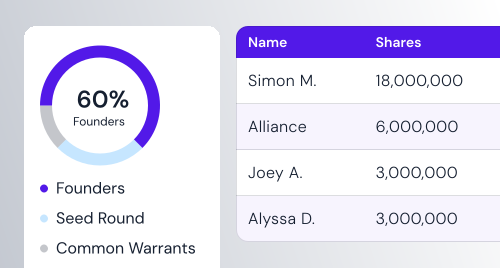
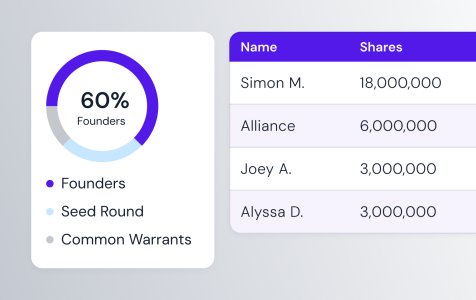
This is why cap-table management, valuation, and the tender-offer process should not live in separate systems. They need to work together, which is exactly what we are building at Eqvista.
What Founders Should Do Now
The first step is to value private-company stock in real time so everyone understands what they are building toward.
When the company improves its product, increases revenue, and earns a stronger market multiple, employees should be able to see how that progress affects the value of their shares. That creates a common goal.
Here is my practical checklist for founders preparing for this new era: